How to Write a Cover Letter That Actually Gets Read: Format, Example & Checklist
Most cover letters restate the resume in paragraph form and open with 'I am writing to express my interest…'. Here's the format that survives a skim, a copyable four-part structure, a real before-and-after opening, and the honest way to use AI without letting it invent your story.
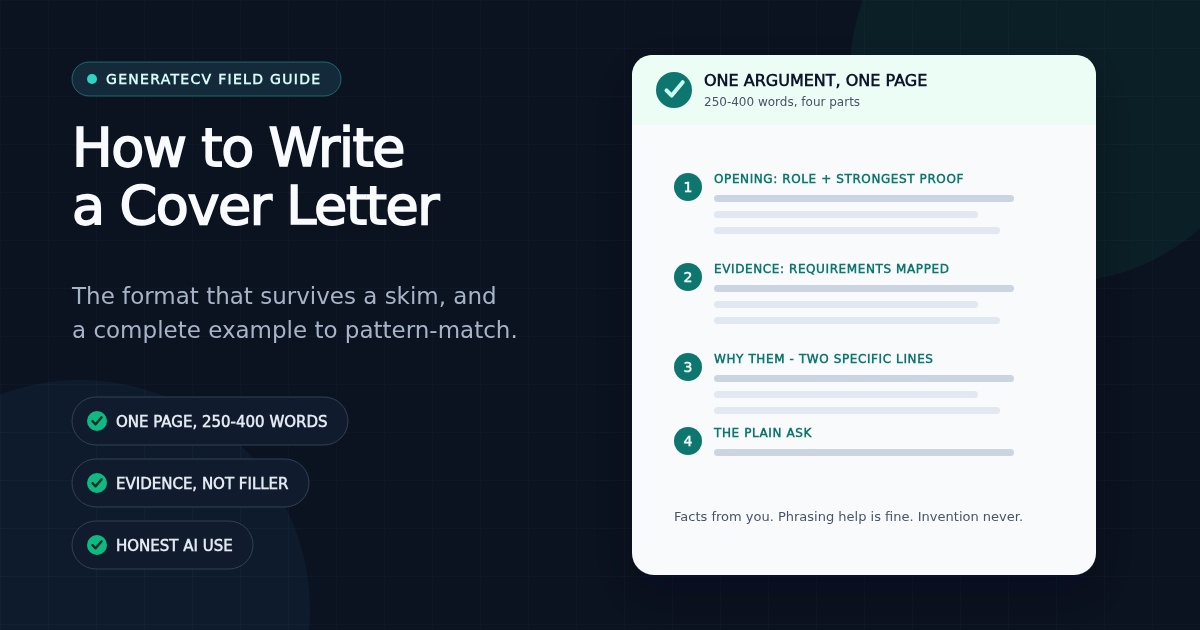
Key takeaways
- A good cover letter is one page, 250–400 words, and makes one argument: here is the overlap between what you need and what I've done.
- Don't restate your resume in paragraph form — pick the posting's two or three most important requirements and put your strongest evidence against each.
- The opening line does most of the work. Name the role and lead with your most relevant proof; never open with 'I am writing to express my interest'.
- Nobody can tell you with certainty whether a given recruiter reads cover letters — surveys disagree. The honest math: the cost is one focused draft, and when it is read, it's often at the margin where decisions happen.
- Use AI for phrasing and structure, never for facts. Every claim in the letter must come from your real history — an invented anecdote can unravel an interview in one follow-up question.
A cover letter is a one-page argument — 250 to 400 words — that connects the job's two or three most important requirements to the strongest evidence in your real experience. Name the role, lead with proof, keep the company paragraph short, and end with a plain ask. That's the whole format. Everything below is how to do each part well, plus a complete example you can pattern-match against.
Two focused companions handle the edges of that structure: use the cover letter length and editing guide when a draft will not fit cleanly on one page, and read cover letter ATS myths and parsing reality before changing wording or layout for an imagined software rule.
Does anyone actually read cover letters?
Honest answer: it depends on the reader, and anyone quoting you a precise percentage is guessing. Recruiter surveys on this disagree with each other year after year — some hiring managers skip letters entirely, some read them only for borderline candidates, and a minority read every one. There is no reliable public number, so we won't invent one.
What you can rely on is the asymmetry. Writing a focused letter costs you twenty minutes with the method below. Skipping it costs you nothing — right up until you're one of two comparable finalists, or a career changer whose resume doesn't explain itself, or an applicant whose posting explicitly asked for a letter. Those are exactly the moments when a letter gets read, and they're also the moments when decisions are made at the margin. Write it for the reader who does open it.
The format that survives a skim
Whoever opens your letter is skimming, the same way they skim resumes. Format for that reality:
- One page, always. 250–400 words. Three to five short paragraphs.
- Same header as your resume — name, phone, email, location — so the pair reads as one document set.
- A real greeting. Use the hiring manager's name if the posting or company page gives you one; otherwise "Dear [Team name] hiring team" beats "To Whom It May Concern" every time.
- No dense blocks. If a paragraph passes four lines, split it or cut it.
- Match the file format the posting asks for, and give the file a professional name:
firstname-lastname-cover-letter.pdf.
The four-part structure
1. The opening: role + strongest proof. One or two sentences. Name the exact role, then attach the single most relevant fact about you — the one thing you'd want the reader to remember if they stopped there.
2. The evidence paragraph(s): requirements → proof. Reread the posting and pick its two or three most important requirements — usually the ones repeated, or listed first. For each, give one concrete example from your history: what you did, at what scale, with what result. This is the same requirement-mapping we use for resumes in mirroring the job description without lying, and the same evidence-first writing that makes resume bullets survive a skim — in sentences instead of bullets.
3. The company paragraph: short and specific. Two sentences on why this company, and only if you can say something a hundred other applicants couldn't paste. A specific product, market position, or problem you'd be walking into beats any amount of "I admire your commitment to excellence."
4. The close: a plain ask. One sentence of intent ("I'd welcome the chance to talk about how I could help with X"), a thank-you, and your name. No begging, no "I know I'm not the most qualified, but…" — never argue against yourself in your own letter.
Before and after: the opening line
These are illustrative examples, not real applicants — but the pattern transfers directly.
Before: "I am writing to express my interest in the Customer Success Manager position at Meridian. I believe my skills and experience make me a strong candidate for this role."
Forty words in, the reader has learned nothing. Every sentence could appear in any letter for any job — which is precisely how it reads.
After: "Your Customer Success Manager posting asks for someone who can cut churn in a self-serve product — that's what I spent the last two years doing at a 4,000-customer SaaS company, where my onboarding redesign took first-90-day churn from 9% to 6%."
Role named, top requirement named, strongest proof attached, numbers included. If the reader stops here, they still got the argument.
A complete example
A fictional but realistic letter for that same posting — 230 words, four paragraphs, every claim concrete enough to be checked in an interview:
Dear Meridian hiring team,

Your Customer Success Manager posting asks for someone who can cut churn
in a self-serve product — that's what I spent the last two years doing at
Brightline, a 4,000-customer scheduling SaaS, where my onboarding redesign
took first-90-day churn from 9% to 6%.

Two parts of the role map directly to my experience. First, you need
someone to own renewal conversations for mid-market accounts. At
Brightline I carried a book of 140 accounts through two renewal cycles at
a 92% gross retention rate, and I built the health-score checklist our
whole team now uses to flag at-risk accounts a quarter early. Second,
you're looking for someone who can turn support patterns into product
feedback. My monthly "top friction" report to product led directly to the
two onboarding changes behind the churn improvement above.

I'm drawn to Meridian specifically because you sell to clinics — my
accounts at Brightline skewed healthcare, and I know how differently a
practice manager evaluates software than a startup does.

I'd welcome the chance to talk about how I'd approach your renewal book.
Thank you for your time.

Jordan Alvarez
jordan.alvarez@example.com · (555) 210-8841 · Portland, OR
Notice what's absent: no life story, no adjectives about being a "passionate team player", no paragraph about their mission statement. Every sentence either maps a requirement to evidence or explains the fit.
Common mistakes that get letters skipped
- Restating the resume in paragraph form. The reader has the resume. The letter's job is selection and argument, not coverage.
- Generic openers. "I am writing to apply for…" wastes the most valuable line on information the subject line already carried.
- The flattery paragraph. Praise a company can't act on ("your inspiring culture") signals template, not research.
- Apologizing. Don't volunteer weaknesses or explain gaps defensively. Address a gap only if it needs one factual sentence of context.
- One letter for every job. If your letter would work for a different company unchanged, it isn't done. Swap-the-logo is the test.
- Overlength. A second page doesn't read as thorough; it reads as unedited.
Using AI honestly (and why it matters more here)
A cover letter is prose, which makes it the easiest document for AI to fill with confident, generic — or worse, invented — claims. The rule we build our own tools around applies doubly here: facts come from you; the tool only helps with phrasing and structure. An AI-invented anecdote in a resume is dangerous; in a cover letter, where you're speaking in the first person, a single follow-up question in an interview can unravel it. We wrote about how easily this happens — and how to audit for it — in why your AI tools shouldn't invent your work history.
Used honestly, AI is genuinely good at this job: it can extract a posting's top requirements, suggest which of your real experiences map to them, and tighten your draft's phrasing. That's exactly the split our cover letter generator makes — it builds the letter from your actual resume and the actual posting, and anything it couldn't source from you stays a visible placeholder for you to fill, never a fabricated claim.
The final checklist
- One page, 250–400 words, three to five paragraphs
- Names the exact role in the first sentence
- Opens with your strongest relevant proof, not a formality
- Maps the posting's top two or three requirements to concrete evidence
- Company paragraph says something only a researcher could say
- Zero sentences that would survive a swap-the-logo test
- Every fact traceable to your real history — including anything AI drafted
- Greeting uses a name or a specific team, not "To Whom It May Concern"
- Same header and file format family as your resume (see our ATS-friendly format guide — letters get uploaded through the same portals)
- Proofread out loud once — cadence catches what spellcheck misses
That's the whole craft: one argument, backed by your real evidence, formatted for a skim, honest end to end. It won't rescue an application aimed at the wrong job — but for the right job, it's the cheapest advantage left that most applicants still skip.
Draft your cover letter in minutes
Paste the job description, add your resume, and get a tailored letter you can edit line by line — built on your real experience, never invented.
Related Articles
Cover Letter Length: The One-Page Editing Guide
Use a practical 250-to-400-word cover letter range, assign space to proof instead of filler, and trim an overlong draft with a paragraph-by-paragraph editing method.
Read articleCover Letter ATS Myths: What Parsing Actually Does
Separate upload and text-extraction reality from cover-letter ATS folklore: file formats, keywords, hidden text, columns, length, and a parsing-safe checklist.
Read articleHow Our Free Resume Checker Calculates Its Score
The category weights, extracted-text checks and limitations behind GenerateCV's local resume report.
Read article