Mirror the Job Description Without Lying
Recruiters find resumes by searching exact terms. Here's how keyword matching actually works — exact phrases, acronym variants, title matching — and how to mirror a posting truthfully instead of stuffing it.
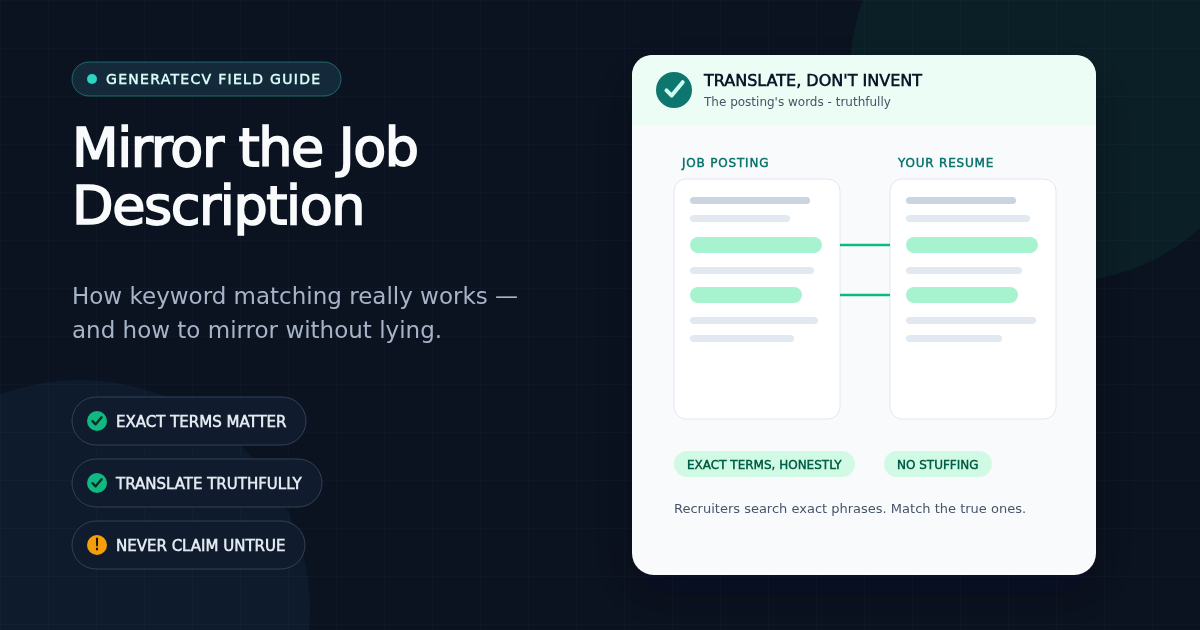
Key takeaways
- Recruiters search databases with exact terms — 'managed ad budgets' won't match a search for 'paid media'.
- Use the posting's exact phrasing for skills you genuinely have; keep both the acronym and the spelled-out form.
- Getting the job title itself into your resume is one of the strongest match signals — use your summary if your official title differed.
- Mirroring is translation, not fabrication: rename what you did, never claim what you didn't.
A recruiter with four hundred applicants doesn't read four hundred resumes. They search. The applicant tracking system is a database, the job description is the source of the search terms, and your resume either contains those terms or it doesn't exist.
That's the entire logic behind "tailor your resume to the job" — advice so worn out that people forget it has a precise, mechanical meaning. We build keyword-matching software, so here's what the machine actually checks, and how to satisfy it without writing fiction.
Exact terms beat synonyms — machines don't read between lines
You wrote "oversaw advertising spend." The posting says "managed paid media budgets." A human knows these are the same thing. A database search for paid media returns nothing from your resume — and that's the whole failure, quiet and total.
When our checker compares a resume against a posting, it filters out the noise words ("responsibilities", "excellent", "candidate") and looks for the meaningful terms as they actually appear. Modern recruiting software works the same way. The practical rule: for every skill in the posting you genuinely have, use the posting's exact phrasing at least once.
Acronyms count as different words
Some systems normalize "K8s" to "Kubernetes" and "SEO" to "search engine optimization" — ours does, and good ones do. Many don't, and you can't know which one is reading you. The safe pattern costs nothing: use both forms once — "search engine optimization (SEO)" on first mention, the short form everywhere after. You're covered in both directions, and it reads naturally to humans.
The job title is its own signal
Whether the posting's actual title appears in your resume is scored separately in most ranking systems — it's one of the strongest signals there is. If you've held the title, make sure it appears verbatim. If your official title was different but the work was the same, don't rewrite history in your work experience — use the summary instead: "Customer Success Manager (titled Account Specialist) with four years of…" — truthful, and the search still finds you.
Placement matters more than repetition
Keyword stuffing — cramming terms into an invisible block or repeating "project management" nine times — has been dead for years; some systems actively penalize it, and every human instantly distrusts it. What actually reads as strong, to both machines and people, is a term that appears where the work happened: once in your skills or summary, and again inside an experience bullet with a result attached. Claimed once, proven once.
The honest boundary
Mirroring is translation, not fabrication. Renaming "oversaw ad spend" to "managed paid media budgets" describes the same true work in the searcher's vocabulary — that's smart writing. Adding "Kubernetes" because the posting wants it and you once watched a tutorial is a lie with a scheduled detonation: keyword matching gets you the interview, and the interview is conducted by a human who will ask about Kubernetes.
The test we always come back to: could you defend every phrase in a conversation with a stranger? If yes, mirror aggressively — use their words, hit the title, cover the acronyms. If no, the keyword isn't yours to use, and no ranking boost is worth walking into an interview holding someone else's resume.
Want to see the match before a recruiter does? Paste the posting into our free checker alongside your resume — it shows exactly which of the posting's terms you match, which you're missing, and whether the title connects. No signup, and your resume stays in your browser.
Check your resume free — no signup
See how your resume scores against real ATS filters in seconds.
Related Articles
The Resume Bullet Formula: 105 Weak-to-Strong Examples
Turn duty statements into specific resume bullets with a repeatable action, scope, result, and method formula, plus 105 worked examples across 35 roles.
Read articleResume Summary Examples That Survive the Skim
Write a specific professional summary with a target role, relevant scope, strongest proof, and fit, using 35 before-and-after examples across ten role families.
Read articleHow Long Should a Resume Be? One Page, Two Pages, or More
One page is the right default for most people early in a career; two pages are earned by roughly a decade of relevant work. What changed in 2026: federal resumes are now capped at two pages — and the internet is still full of advice telling you to write five.
Read article