How Long Should a Resume Be? One Page, Two Pages, or More
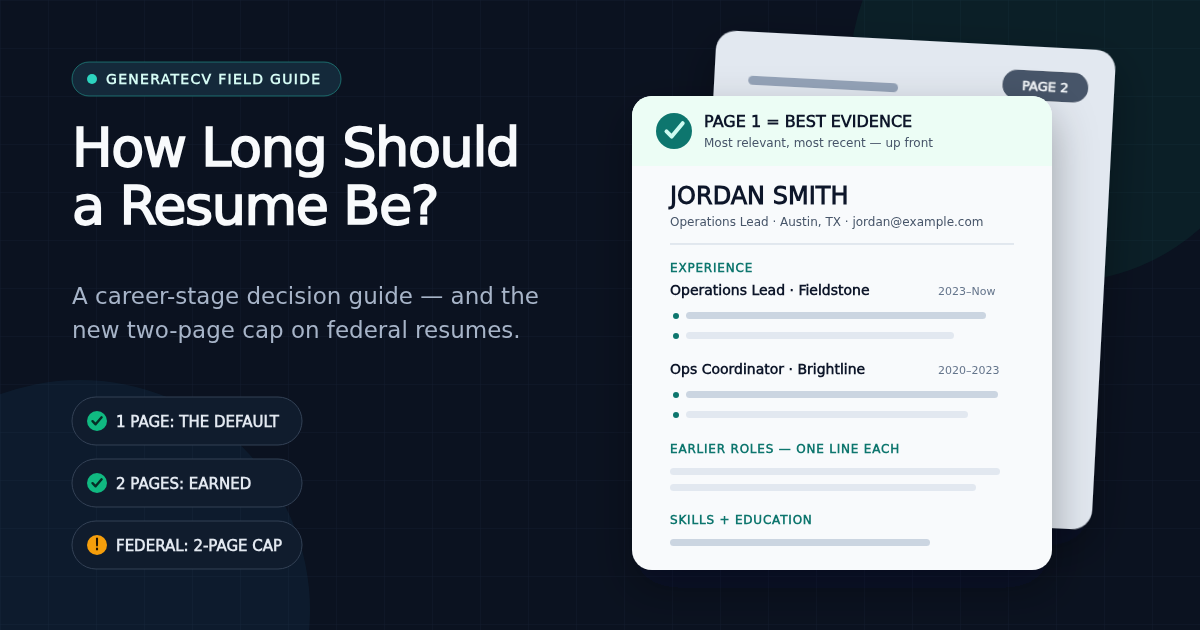
One page is the right default for most people early in a career; two pages are earned by roughly a decade of relevant work. What changed in 2026: federal resumes are now capped at two pages — and the internet is still full of advice telling you to write five.
Key takeaways
- Length follows relevant evidence, not tenure. One page is the default until roughly ten years of experience that genuinely relates to the jobs you're applying for.
- Two pages are legitimate and widely accepted for experienced candidates — the claim that recruiters auto-reject a second page has no evidence behind it.
- Federal resumes changed in 2025: agencies now accept a maximum of two pages under the Merit Hiring Plan, and USAJOBS blocks longer uploads. Most advice online still says the opposite.
- Academic CVs are a different document with different rules — no page cap, but only for genuinely academic applications.
- Cut content before you shrink formatting: per-application relevance first, one-line summaries for old roles, two-line bullets, and no filler sections.
For most people, a resume should be one page — until roughly ten years of experience that's genuinely relevant to the jobs you're applying for, at which point two pages are normal and safe. Academic CVs follow different rules entirely, and US federal resumes are now capped at two pages — a 2025 change much of the internet hasn't caught up with. The rest of this guide is how to decide your case, and how to cut when you're over.
The real rule: length follows evidence, not tenure
Page count is the wrong thing to optimize directly. The question a resume answers is "what has this person done that's relevant to this job?" — and the right length is however much space your genuinely relevant evidence needs, and not a line more. A second page earned by eight relevant roles reads as depth. A second page filled with a 2009 internship, an "objective" paragraph, and hobbies reads as an unedited first page.
That's why tenure alone doesn't justify length. Fifteen years in one narrow specialty applying within that specialty? Two tight pages. Fifteen years across three unrelated fields, applying to the third? The first two fields compress to a few lines each — you're back near one page, and stronger for it.
Resume length by career stage
| Situation | Default length | When to break the default |
|---|---|---|
| Student / new graduate | One page | Almost never — thin content spread over two pages advertises the thinness |
| Early career (up to ~5 years) | One page | Dense, directly relevant project or contract work can justify spilling over |
| Mid-career (~5–15 years) | One to two pages | Use two only when page two is real evidence, not overflow |
| Senior / executive | Two pages | Rarely more — even executive recruiters skim; a third page seldom gets read |
| US federal (USAJOBS) | Up to two pages — hard cap | Never: agencies can't accept longer, and USAJOBS blocks the upload |
| Academic (CV) | As long as the record requires | Different document — publications, grants, and teaching are expected in full |
The federal resume rule changed — most advice hasn't
For years, standard guidance said federal resumes should run three to five pages of exhaustive detail. That era is over. USAJOBS now states that "federal agencies only accept resumes up to two pages in length to comply with the Merit Hiring Plan," and that USAJOBS "will not allow you to upload or build resumes longer than two pages." That's not a preference — the upload is blocked.
If you're applying federally with an old five-page federal resume, the job now is aggressive selection: keep the experience blocks that map to the announcement's qualifications (with hours per week and month/year dates, which USAJOBS still asks for), and cut the rest. Treat any article telling you "federal resumes have no page limit" as your signal that the rest of its advice is stale too.
When two pages is the right answer
Two pages are correct when all three of these are true:
- You have roughly ten or more years of experience related to this application;
- Page two contains evidence — quantified accomplishments, relevant roles, certifications — not overflow padding;
- The most important material still lives on page one, because skimming readers may never reach page two.
Structure for the skim: your strongest, most recent, most relevant roles belong on page one. Page two is for supporting history — earlier roles in compressed form, education, certifications, publications if they matter. And at either length, the file still has to survive the upload: the ATS-friendly format rules apply to a two-pager exactly as they do to one page.
How to cut a resume that runs long
Cut content before you touch formatting. In order of what to do first:
- Apply the this-application test. For every line, ask: does this help this application? Relevance is decided by the job posting, not by how proud you are of the line — the same selection logic as mirroring the job description honestly.
- Compress everything older than ~10 years. Early roles become one line each — title, employer, dates. If an old role is your most relevant evidence, that's a sign to restructure, not to keep four pages (see choosing a resume format).
- Deduplicate responsibilities across roles. If three jobs say "managed client relationships," prove it once with your best example and let the other roles carry different evidence.
- Delete the filler sections. Objective statements, "references available upon request," generic soft-skill lists, and hobbies unrelated to the work — none of them earn their lines.
- Cap bullets at two lines. A bullet that wraps to three lines is a paragraph in disguise; rewrite it around the outcome and it usually fits in one.
- Only then adjust the layout. Spacing and margins have honest room before readability suffers — we've published exact ranges in resume font size, margins, and spacing. The floor to respect: don't go below 10-point body text or half-inch margins, the same minimums MIT's career office recommends. A resume squeezed below that reads as cramped before it reads as impressive.
The folklore we can't verify (so we won't repeat it)
You'll find articles claiming recruiters "reject two-page resumes on sight," or that "76% of hiring managers prefer" some specific length. We looked for the studies behind these claims and found survey marketing and circular citations — the same pattern as the ATS auto-rejection myth. What's actually defensible: readers skim, front-load your best evidence, and thin content spread thick is obvious to anyone who reads resumes for a living. None of that requires a fake percentage.
One honest caveat in the other direction: length norms are conventions, not laws, and they vary by country and industry. When a posting or a recruiter tells you what they want, that instruction beats every default in this article.
Sources and notes
- USAJOBS: What to include in your resume — the two-page federal cap under the Merit Hiring Plan and the upload restriction; checked August 2, 2026.
- MIT Career Advising & Professional Development: Resumes — one-page guidance for students ("unless you have extensive experience or an advanced degree"), 10-point minimum font, half-inch minimum margins; checked August 2, 2026.
- Career-stage defaults reflect our editorial judgment from reviewing resumes and hiring guidance — they are conventions, not measured outcomes, and we label them as such.
Check your resume free — no signup
See how your resume scores against real ATS filters in seconds.
Related Articles
The Resume Bullet Formula: 105 Weak-to-Strong Examples
Turn duty statements into specific resume bullets with a repeatable action, scope, result, and method formula, plus 105 worked examples across 35 roles.
Read articleResume Summary Examples That Survive the Skim
Write a specific professional summary with a target role, relevant scope, strongest proof, and fit, using 35 before-and-after examples across ten role families.
Read articleReverse-Chronological, Functional, or Combination: Choosing a Resume Format That Doesn't Hide Your Evidence
The three resume structures solve different problems — and the wrong one hides exactly the evidence a recruiter or parser goes looking for. A comparison table, a five-question decision path, and honest recommendations for career changers, gaps, and contractors.
Read article