Reverse-Chronological, Functional, or Combination: Choosing a Resume Format That Doesn't Hide Your Evidence
The three resume structures solve different problems — and the wrong one hides exactly the evidence a recruiter or parser goes looking for. A comparison table, a five-question decision path, and honest recommendations for career changers, gaps, and contractors.
Key takeaways
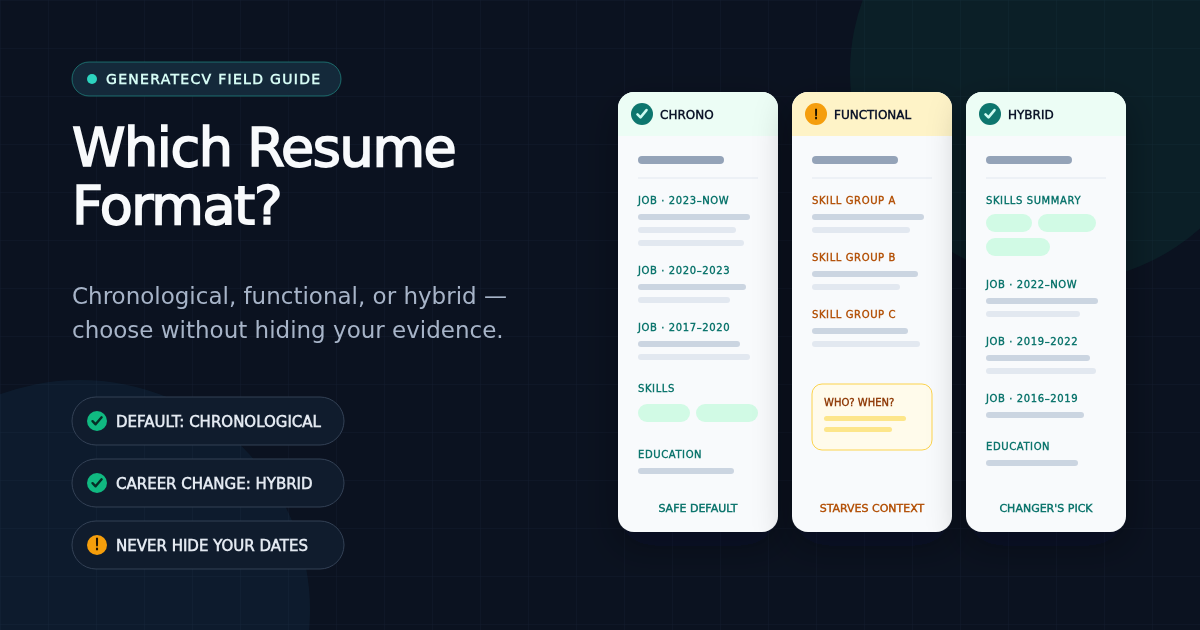
- Reverse-chronological is the default for a reason: it presents your evidence the way recruiters and resume parsers both expect — titles, employers, and dates in order.
- A purely functional resume rarely helps. It doesn't get you auto-rejected, but it starves the reader (and the parsed profile) of the who/when context that makes skills believable.
- The combination format is the honest middle path for career changers and gap situations: a skills-led opening backed by a complete, dated work history below it.
- Recruiters read format changes as signals. Hiding dates or employers raises the exact question you were hoping to avoid.
- Choose with five questions: relevance of recent work, career direction, gap pattern, contractor/stint history, and seniority — not with a template's aesthetics.
Use reverse-chronological — most recent job first, with dates — unless you have a specific structural problem to solve. If you're changing careers or explaining an unusual path, use a combination format: a skills-led summary up top, full dated history below. A purely functional resume (skills only, work history minimized) is almost never the right call — not because software rejects it, but because it hides the evidence every reader goes looking for.
The three formats, defined
Reverse-chronological
Work experience is the spine: each role lists title, employer, dates, and accomplishment bullets, newest first. Skills and education support from below (or above, for recent graduates). This is the structure recruiters see most, and the one that answers their first three questions — where, as what, how recently — without any digging.
Functional (skills-based)
Skill groupings are the spine: "Leadership," "Data Analysis," "Operations," each with achievement bullets pulled from across your career. Employers and dates are compressed into a bare list at the bottom — or omitted. The intent is to foreground capability over timeline; the effect is usually to detach every achievement from its context.
Combination (hybrid)
A skills or summary section leads — typically a headline, three to five proof-backed skill statements, or a short highlights block — and a complete reverse-chronological history follows. You control the first impression and keep the verifiable timeline intact.
Side by side
| Reverse-chronological | Functional | Combination | |
|---|---|---|---|
| What leads | Recent work history | Skill groupings | Skills summary, then full history |
| Best for | Steady progression in one field | Almost no one (see below) | Career changers, returners, unusual paths |
| What it shows well | Trajectory, recency, employer context | Breadth of transferable skills | Direction + full verifiable record |
| What it hides | Nothing — which is the point | When and where anything happened | Little, if history stays complete |
| Reader's reaction | Neutral default | "What is this resume avoiding?" | Neutral, if the summary is honest |
| Parsed profile quality | Complete roles with dates | Sparse — achievements without context | Complete, plus a keyword-rich opening |
What parsing actually does with each format
Let's be precise, because this is where format advice usually goes off the rails. Applicant tracking systems parse resumes into structured profiles — Lever's parsing documentation, for example, describes extracting organizations, positions, dates, and contact details into candidate records. A reverse-chronological resume feeds that extraction exactly the shape it expects. A functional resume gives it achievements with no employer or date to attach them to — so the parsed profile, and any recruiter search against it, ends up thin.
What a functional format does not do is trigger an automatic rejection. No mainstream vendor documents anything like "reject skills-based resumes," and the auto-rejection story is mostly myth anyway. The honest statement is narrower and still decisive: the format degrades what the database knows about you and what the human can verify — the same reason our ATS-friendly format guide pushes predictable structure everywhere else.
Five questions that pick your format
- Is your most recent experience your most relevant? Yes → reverse-chronological, done. This covers most people.
- Are you moving toward a different kind of work? Career change → combination: lead with the transferable evidence the new field cares about, keep the dated history complete below.
- Do you have gaps you're tempted to hide? Don't hide them — dropping dates raises the question louder. Keep chronology, use years-only dates if months make small gaps look bigger than they were, and spend one honest line of context where needed.
- Is your history a stack of short stints? Contractors, freelancers, agency staff: group engagements under one umbrella entry ("Independent Consultant, 2021–2025" with client bullets beneath). That's a chronological resume with smart grouping — not a functional one.
- Are you early-career with little history? Recent graduates: stay chronological but let education, projects, and internships lead. Structure follows your best evidence — it doesn't fake a different shape for it.
The scenarios, worked through
Career changer (marketing → UX research). Combination. Open with a three-line summary naming the target role and the bridge evidence — user interviews run, A/B tests designed, a completed certification. History below stays complete: the marketing titles explain where the research skills actually come from, which is what makes them credible.
Two-year caregiving gap. Reverse-chronological, gap left visible. One line — "Career break for family caregiving, 2023–2025" — answers the question and moves on. A functional restructure to bury two years reads as evasive and sacrifices the strong history you actually have.
Contractor with nine engagements in five years. Chronological with grouping: one "Independent Contractor" entry, client work as bullets, each naming the client type, the deliverable, and the result. Nine separate entries would read as churn; zero dates would read as hiding.
Recent graduate. Chronological with education first: degree, then projects with real outcomes, then internships and part-time work. Employers expect thin history at this stage — thin history presented plainly beats skills theater.
Fifteen steady years in one field. Reverse-chronological, no debate — and your problem is length, not structure. See how long a resume should be for the compression rules.
If in doubt: the hybrid default
When none of the scenarios fit cleanly, the combination format at its lightest — a two-to-four-line summary above a complete chronological history — is the safest structure that still gives you editorial control. It's the shape most of our templates default to, it parses into a complete profile, and it lets you mirror each posting's language in the summary without touching the factual record below it.
Sources and notes
- Lever: Understanding resume parsing — the fields parsers extract into candidate profiles; checked August 2, 2026.
- Greenhouse: Unsuccessful resume parse — formatting patterns documented to cause partial parsing; checked August 2, 2026.
- Reader-reaction characterizations ("what is this resume avoiding?") are editorial judgment from hiring practice, labeled as such — we found no controlled study measuring format-specific rejection rates, and we'd treat any precise percentage you see elsewhere with suspicion.
Check your resume free — no signup
See how your resume scores against real ATS filters in seconds.
Related Articles
The Resume Bullet Formula: 105 Weak-to-Strong Examples
Turn duty statements into specific resume bullets with a repeatable action, scope, result, and method formula, plus 105 worked examples across 35 roles.
Read articleResume Summary Examples That Survive the Skim
Write a specific professional summary with a target role, relevant scope, strongest proof, and fit, using 35 before-and-after examples across ten role families.
Read articleHow Long Should a Resume Be? One Page, Two Pages, or More
One page is the right default for most people early in a career; two pages are earned by roughly a decade of relevant work. What changed in 2026: federal resumes are now capped at two pages — and the internet is still full of advice telling you to write five.
Read article