The Bullet Points Recruiters Skip — and the Four Words That Flag Them
We built a detector that flags weak resume bullets, and the same few phrases trip it constantly: 'responsible for', 'helped with', 'worked on', 'duties included'. Here's why they fail and how to rewrite each one.
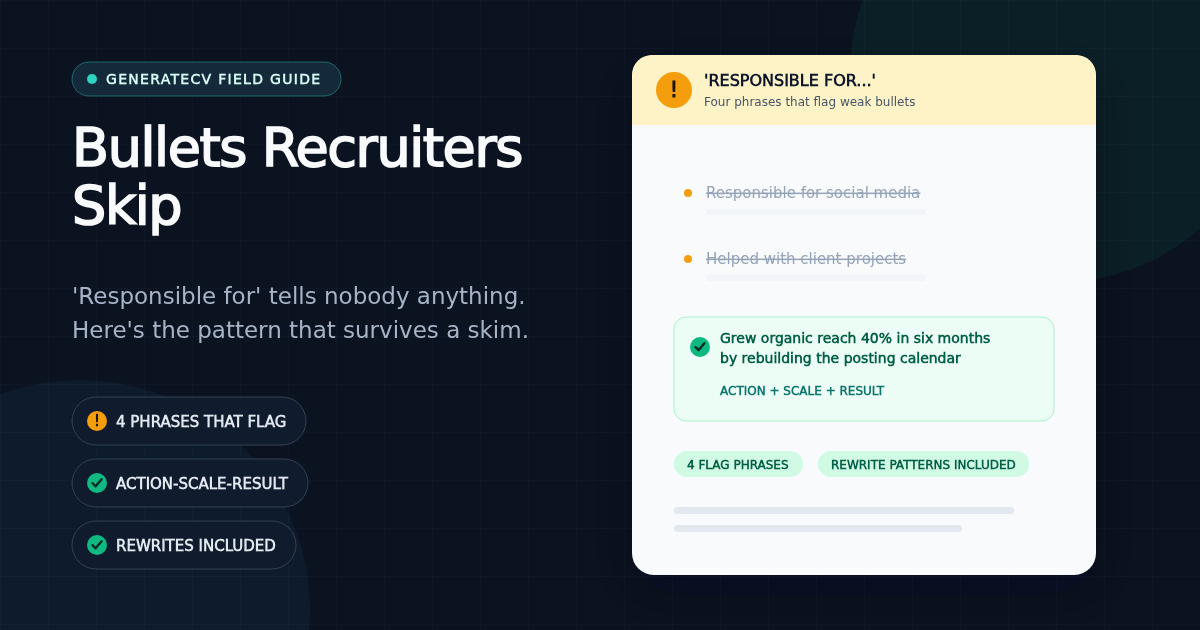
Our resume checker includes a detector that flags weak bullet points — we call them fluff internally. After watching it run against real resumes, the pattern is almost embarrassing: the same handful of openers account for most of what it catches.
- "Responsible for…"
- "Helped with…"
- "Worked on…"
- "Duties included…"
None of these are grammatically wrong. They fail for a sharper reason: they describe your job posting, not your performance. "Responsible for cash handling" is true of everyone who ever held the role, including the person who got fired from it. A recruiter reading it learns what your job was supposed to be — not whether you were any good at it.
What the strong bullets do differently
Every strong bullet answers two questions in one line: what did you do (a real action verb) and what changed because you did it (a number, a scale, an outcome). That's the whole formula. Our detector scores bullets on exactly those two signals — verb strength and measurable results.
Same experience, rewritten:
| What the detector flags | What passes |
|---|---|
| Responsible for cash handling | Balanced a $10,000 daily cash drawer with zero discrepancies across 2 years |
| Helped with social media | Grew Instagram engagement 40% in 6 months by shifting to short-form video |
| Worked on customer service | Resolved 30+ tickets daily with a 95% satisfaction rating |
| Duties included training new staff | Onboarded and trained 12 new hires; 11 passed probation review first-try |
Notice nothing was exaggerated. The right side is the same work — the difference is that it commits to specifics. Specifics are what make a claim checkable, and checkable is what makes it credible.
"But I don't have numbers"
The most common objection, and it's usually wrong in an interesting way: you don't have numbers recorded, but you almost always have them estimable. How many customers in a shift? How many tickets in a day? How big was the team? How often did the report go out? Honest approximations with a qualifier — "roughly 100 covers a night", "a team of 6" — are entirely legitimate and read miles better than nothing.
Two places numbers hide that people forget: frequency(daily? weekly? 40 times a season?) and scale (for how many people? across how many locations? at what dollar value?). Neither requires access to a company dashboard you no longer have.
The verb is a cheap upgrade — the metric is the real one
Advice articles love verb lists — swap "helped" for "spearheaded" and so on. Verbs matter (our detector does score them), but be honest about the limits: "Spearheaded cash handling" is still an empty bullet wearing a nicer jacket. Upgrade the verb and attach the outcome, or you've only done cosmetics.
A decent test for any bullet: could a stranger challenge it in an interview? "Tell me about the zero discrepancies" is a conversation you can win. Nobody can even ask a question about "responsible for cash handling" — and that's precisely the problem.
Check your own
Our free checker runs this exact analysis — it lists which of your bullets got flagged and why, no account needed. Or do it manually: scan your resume for the four openers at the top of this article. Every one you find is a line telling recruiters what your job was, when it could be telling them how well you did it.
Check your resume free — no signup
See how your resume scores against real ATS filters in seconds.
Related Articles
The Resume Bullet Formula: 105 Weak-to-Strong Examples
Turn duty statements into specific resume bullets with a repeatable action, scope, result, and method formula, plus 105 worked examples across 35 roles.
Read articleResume Summary Examples That Survive the Skim
Write a specific professional summary with a target role, relevant scope, strongest proof, and fit, using 35 before-and-after examples across ten role families.
Read articleHow Long Should a Resume Be? One Page, Two Pages, or More
One page is the right default for most people early in a career; two pages are earned by roughly a decade of relevant work. What changed in 2026: federal resumes are now capped at two pages — and the internet is still full of advice telling you to write five.
Read article