How Our Free Resume Checker Calculates Its Score
The category weights, extracted-text checks and limitations behind GenerateCV's local resume report.
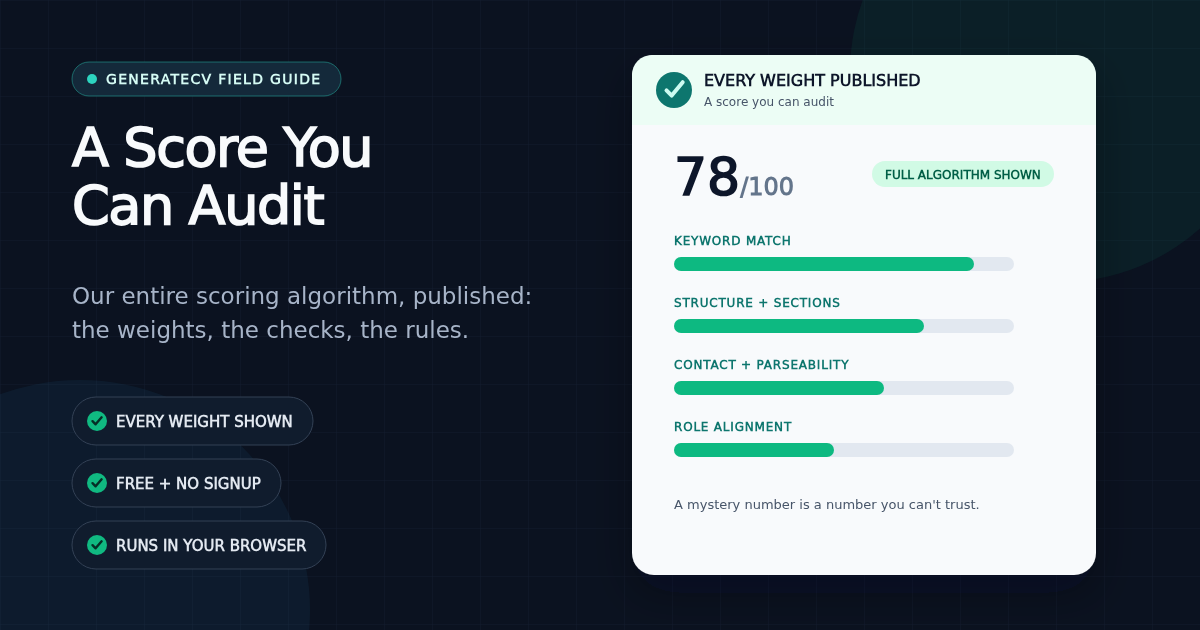
Methodology 2026.10.3. This is a repeatable check of the text our extractor reads, not an employer's ATS score, an interview prediction or the builder's completion percentage.
The score is a weighted sum
Each check contributes an internal value from zero to one hundred. Multiply it by the weight below, add the contributions and round the total. Skills, education and extracted-text readability appear as checkmarks and evidence, not proficiency grades. The on-screen report and downloaded PDF use the same assessment.
| Category | Weight | What it measures |
|---|---|---|
| Achievement clarity | 30% | English-language action verbs, measurable outcomes and duty-first phrasing. |
| Skills section text | 25% | Presence of text under Skills or a recognized equivalent; not skill quality or proficiency. |
| Contact details | 20% | Email and plausible phone detection in the extracted text. LinkedIn is optional. |
| Education / training text | 15% | Presence of text under a recognized Education or Training heading; not qualification quality. |
| Extracted-text readability | 10% | Replacement characters and possible column residue. Original layout and employer parsing are not certified. |
Skills and education are section-presence checks. A high score does not establish relevant expertise, factual accuracy or eligibility for a job. Education may not apply to every resume; only include qualifications you actually hold.
Extraction comes before interpretation
PDF, DOCX and TXT are supported within the reading limits shown in the uploader. Password-protected, image-only, damaged and legacy Word files have a recovery path: another export or pasted text. We do not perform OCR.
The editor shows the entire extracted text for review. PDF pages with very little text are flagged, even when other pages are readable. Compare their content with the original before accepting the partial extraction. Short or oversized input receives no numerical report.
Recognized headings and common aliases help identify sections. List markers are removed before grading an achievement, and wrapped continuation lines are reconstructed. Employment dates and contact numbers must not count as achievement metrics.
Within Experience and Projects, unmarked statements can be read even when copying a PDF loses its bullet glyphs. Contact, role and date lines are excluded, along with lists in Skills, Education and Languages. An unfamiliar opening word alone is not a reason to call a measured contribution unclear; weak duty-first openers remain a coaching flag.
What the formatting checks cannot prove
Text with column-like spacing merits a reading-order check, not an automatic rejection. Missing contact text does not establish that it was stored in a header. Normal bullet glyphs and pipes are not proof of a broken export. Pasted text cannot reveal the source document's fonts, hidden text, tables or visual layout.
Employer parsers can have different limits. For example, Greenhouse's parsing guidance lists columns, headers, image-only documents and spaced letters as possible causes of partial or unsuccessful parsing. Successful reading in our checker does not certify the employer's parser.
Job-description overlap is a separate signal
We compare unique meaningful terms and recognized skill aliases in the two texts. AWS and Amazon Web Services can match; repeating a keyword does not increase the overlap. JavaScript does not establish a Java match. Displayed term lists are limited.
The overlap percentage does not change the resume score and is not the percentage of requirements you meet. A missing term is not proof of a missing ability. Add wording only when it accurately describes your experience; keyword stuffing is not the goal.
Optional AI advice does not control the score
Local checks run in your browser without an account or resume upload. Optional AI advice is a separate, explicit request after sign-in. It sends the resume text and job description to our AI service and uses your plan's metered ATS allowance. Long inputs may be reviewed as a bounded excerpt.
AI suggestions are shown separately. They cannot replace the deterministic score, category evidence or observed strengths. Review every suggestion yourself and never add invented achievements, employers, qualifications or numbers. An AI failure or allowance limit leaves the local report available.
Use the findings, not a pass/fail threshold
Our offline fixtures are synthetic regression tests, not a representative accuracy study or vendor certification. English-language achievement heuristics may not fit every language, profession or writing style. We do not publish an industry percentile or claim that a particular score earns an interview.
Start with the resume checker, inspect the extracted text and work through the specific findings. Then review your exported PDF or DOCX against the format checklist and the employer's own requirements.
Run the free check — no signup
See exactly how your resume scores against real ATS filters — free, unlimited, and it stays in your browser.
Related Articles
ATS-Friendly Resume Format: A Practical Checklist and Template
An ATS-friendly resume is not a document stuffed with keywords or stripped of personality. It is a readable resume whose text extracts in the right order, uses recognizable sections, and proves the requirements of one real job.
Read articleNo, an ATS Probably Didn't Auto-Reject Your Resume
The '75% of resumes are rejected by ATS' statistic traces back to a defunct vendor with no published methodology. Here's what applicant tracking systems actually do — and what actually gets resumes skipped.
Read articleWe Measured What ATS Parsers Actually See Inside Your PDF
We rendered PDFs at increasing heading letter-spacing and extracted their text layers. Past a measurable threshold, 'EXPERIENCE' becomes 'E X P E R I E N C E' — invisible to keyword search. Here's the data, and the 30-second way to test your own resume.
Read article