Your AI Resume Builder Shouldn't Invent Your Work History
AI resume tools quietly fabricate employers, dates, and metrics that look completely real — ours did too, until we caught it. Here's the placeholder method we built instead, and how to audit any AI-written resume.
Key takeaways
- AI resume generators routinely invent realistic-looking employers, dates, and metrics — indistinguishable from your real history.
- A fabricated resume can survive until a background check or interview question, then end the process instantly.
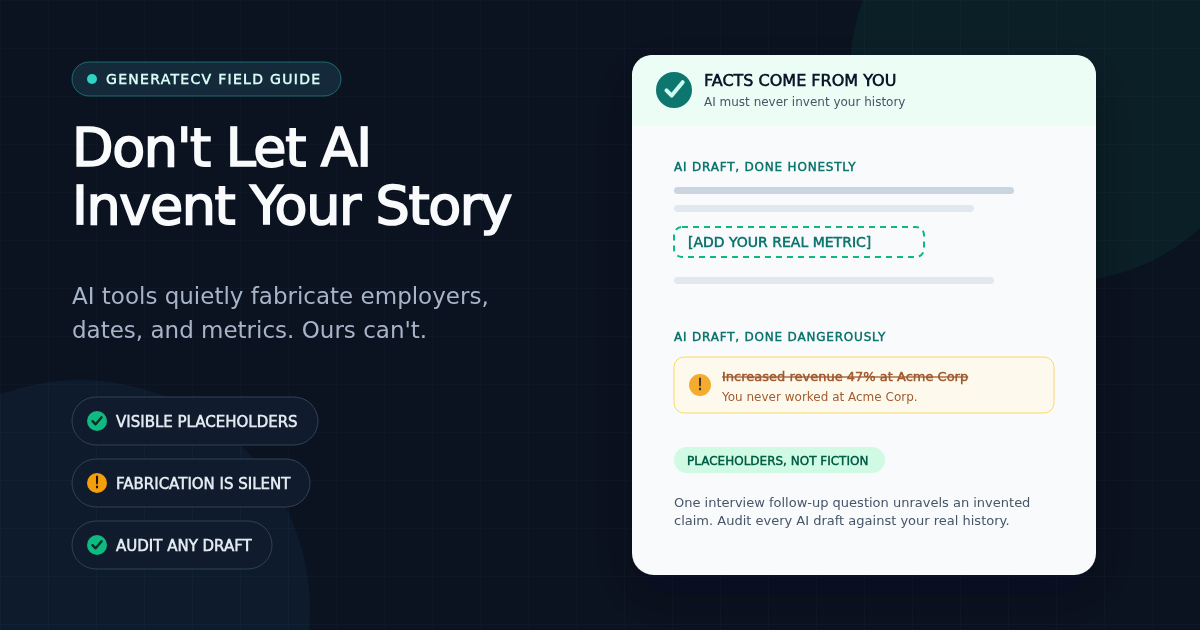
- Our fix: the AI writes everything it legitimately can, and marks unknowable facts as visible [placeholders] you fill in.
- Using any AI tool? Audit every specific fact — every name, number, and date — before a resume leaves your machine.
During testing, we asked our own AI to fast-track a barista resume. It delivered a beautiful one: "Downtown Brew Co., Mar 2021 — Present. Processed 150+ transactions per shift using Square POS. 95% positive feedback rate."
Every word invented. There is no Downtown Brew Co. Nobody measured a feedback rate. And the dangerous part wasn't that the AI made things up — it's that the fabrication was indistinguishable from real experience, one Download click away from being sent to actual hiring managers under someone's real name.
This isn't unique to us — it's how AI resume generation broadly works. Ask a language model for a "complete" resume and it completes it, with plausible employers, tidy date ranges, and metrics that sound earned. Most tools ship exactly that. We decided we couldn't.
Why fabricated resumes are worse than empty ones
- They fail at the worst possible moment. A fake employer survives the application, the screen, maybe the first interview — and detonates at the background check or the casual "tell me about your time at Downtown Brew" question. By then the process ends AND your name is attached to a fabrication.
- You stop noticing them. After three edits of a resume the AI drafted, the invented details feel like furniture. People genuinely lose track of which metrics were theirs.
- An empty field asks to be filled. A fake field asks to be believed. The blank version of your resume is honest about what's missing; the fabricated version lies on your behalf.
The placeholder method
The fix we landed on is almost embarrassingly simple. The AI still drafts the whole resume — structure, summary, professional bullet points, skills, all fully written. But any fact only you could know gets a visible bracket instead of a plausible invention:
- Employers →
[Previous Restaurant] - Dates →
[Dates] - Numbers → "Processed
[X]transactions per shift" - Schools and credentials →
[Your School],[Certification]
The draft still feels ~70% done in seconds — that instant-scaffold moment is the whole reason AI drafting is useful. But nothing pretends to be your history. Then the assistant swaps brackets for your real details one quick question at a time, and you watch the resume become genuinely yours.
And because a rule an AI "should follow" isn't a guarantee, we enforced it in the product itself: the progress meter refuses to call a resume "Strong" while placeholders remain, and the export button warns you before any bracket leaves the building. Honesty as architecture, not as a vibe.
Using any AI resume tool? Audit like this.
Whatever tool you use — including a raw chatbot — run this pass before the resume goes anywhere:
- Highlight every specific fact the AI wrote: company names, dates, percentages, dollar figures, team sizes, tool names.
- For each one, ask: could I defend this in an interview? Not "is it plausible" — could you personally tell the story behind that number to a stranger?
- Replace or delete anything you can't. An honest approximation you can stand behind ("roughly 100 covers a night") beats a precise invention every time.
- Check the boring fields too — AI-invented date ranges are the ones people miss, and they're exactly what background checks compare.
AI drafting is a genuinely great way to beat the blank page — we built a whole product on it. Just make sure the thing wearing your name is made of your life. If you want the version where the machine enforces that instead of you having to remember, that's what we build.
Check your resume free — no signup
See how your resume scores against real ATS filters in seconds.
Related Articles
Who Actually Hires Juniors? 157,622 Live Postings, Counted
We counted every live posting on our job corpus by seniority marker. The entry-level wall is real, but it is wildly uneven by field — and 72% of postings never declare a level at all.
Read articleThe Most In-Demand Skills of 2026, From 102,486 Live Job Postings
We pattern-matched 102,486 live openings on 2,273 company career boards. The most-demanded skills aren't tools: collaboration (61%) and communication (57%) outrank every named technology — Python tops the tool list at 15.6% — and certifications now appear about as often as bachelor's degrees.
Read articleWhat 105,000 Live Job Postings Reveal About the 2026 Job Market
First-party data from 2,036 company career boards: 48% of postings now mention AI, real openings close in a median of 13 days, 1 in 6 'open' jobs is 60+ days old, and senior titles outnumber entry-level 15 to 1.
Read article