Who Actually Hires Juniors? 157,622 Live Postings, Counted
We counted every live posting on our job corpus by seniority marker. The entry-level wall is real, but it is wildly uneven by field — and 72% of postings never declare a level at all.
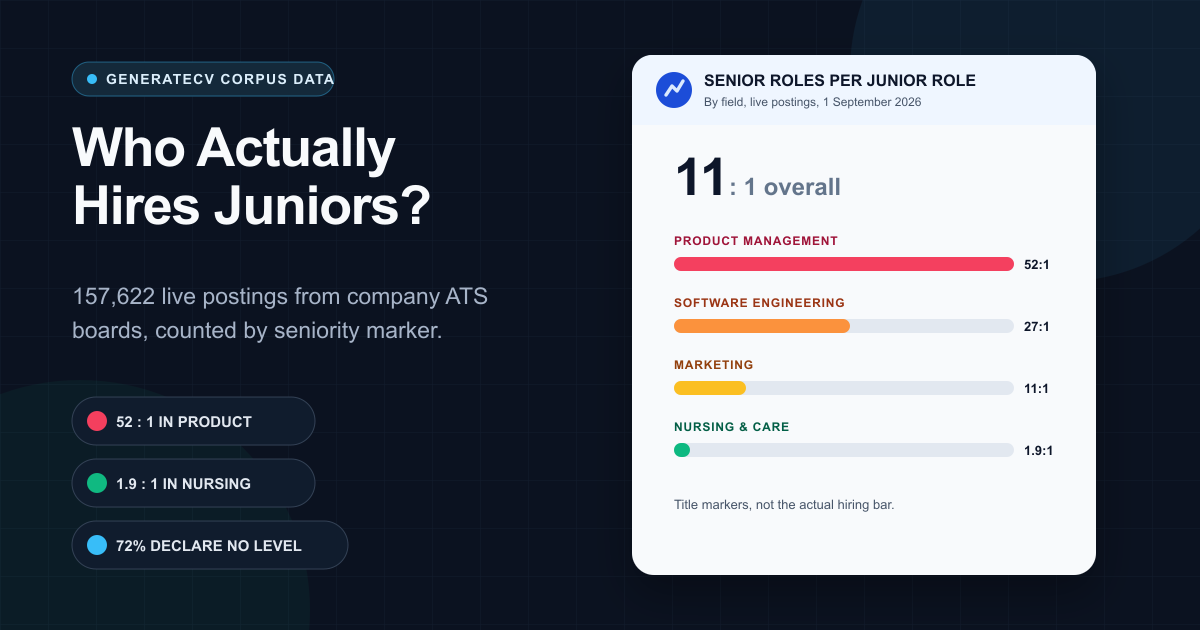
Key takeaways
- Across 157,622 live postings, senior-marked titles outnumber entry-marked ones roughly 11 to 1.
- The wall is field-specific, not universal: product management runs about 52 senior titles per junior title, while nursing and care runs about 1.9.
- Nearly 72% of live postings carry no seniority word in the title at all — that unlabelled majority is where most realistic applications live.
- Title markers measure labelling, not the actual bar. Requirements sections are the honest signal; titles are marketing.
- Numbers describe employers running public applicant-tracking boards, observed since 8 July 2026 — a large current sample, not a census of the labour market.
"Every entry-level job wants five years of experience" is the most repeated complaint in job-seeking, and it is almost never accompanied by a number. We can supply one. GenerateCV keeps a live corpus of openings pulled directly from companies' own applicant-tracking boards, so we counted the whole thing by seniority marker.
On 1 September 2026 that corpus held 157,622 live postings across 3,008 employers. The short version: the entry-level wall is real, it is far worse in some fields than others, and the single largest group of postings is one nobody talks about.
First, the honest fine print
These postings come from company-run ATS boards (Greenhouse, Ashby, Lever, SmartRecruiters, Workable, Recruitee), not scraped aggregators, so there is no expired inventory and no duplicated reposts. That skews the sample toward employers modern enough to run those systems, though it includes plenty of healthcare, logistics, retail and finance alongside tech.
Seniority here is measured only by explicit title markers. "Senior", "staff", "principal", "lead" and "director" count as senior; "junior", "intern", "entry", "graduate" and "apprentice" count as entry. A posting titled simply "Software Engineer" counts as neither, which turns out to matter enormously. We are counting how employers label roles, which is not the same as how hard they actually are to get.
The overall number: about 11 to 1
Across the full corpus, 40,702 live postings carry a senior-level marker and 3,737 carry an entry-level one. That is roughly eleven senior-marked openings for every junior-marked opening. If you are early in a career and searching by title, the frustration is not in your head — the labelled supply really is that lopsided.
The wall is field-specific, not universal
Splitting the same postings by field is where the flat "nobody hires juniors" story falls apart. The ratio swings by more than an order of magnitude depending on what you do.
| Field | Senior-marked | Entry-marked | Senior per entry |
|---|---|---|---|
| Product management | 1,567 | 30 | 52 : 1 |
| Software engineering | 6,563 | 241 | 27 : 1 |
| Data & analytics | 1,415 | 55 | 26 : 1 |
| Design | 897 | 51 | 18 : 1 |
| Customer support | 331 | 23 | 14 : 1 |
| Marketing | 1,740 | 165 | 11 : 1 |
| Sales | 2,176 | 242 | 9 : 1 |
| Nursing & care | 118 | 62 | 1.9 : 1 |
Product management is effectively a closed door at the labelled entry level: 52 senior titles for every junior title, with just 30 junior-marked product openings in the entire corpus. Software engineering and data — the two fields most often recommended to career changers — sit at 27 and 26 to one. Meanwhile nursing and care runs at 1.9 to one, the only field in the set that looks close to balanced.
The practical read: advice like "just get into tech" is aimed at the fields with the steepest labelled entry ratios in the market. That does not make it wrong, but it should change how long you expect the search to take relative to a field hiring juniors at ten times the rate.
The 72% nobody counts
Here is the finding that reframes the rest. Senior-marked and entry-marked postings together are only 44,439 of 157,622 openings. The other 113,183 postings — 71.8% of the live market — carry no seniority word in the title at all.
That unlabelled majority is not a rounding error; it is the market. A posting titled "Software Engineer", "Account Manager" or "Analyst" tells you nothing about the bar until you read its requirements, and those requirements vary enormously between two identically titled roles at two companies. Filtering your search on the word "junior" therefore discards roughly seven of every ten real openings before you have read a single line of any of them.
What this means for how you apply
Three things follow from the numbers, and none of them are "apply harder".
- Judge postings by requirements, not titles. With 72% of openings unlabelled, the requirements section is the only reliable seniority signal available to you.
- Expect field-shaped timelines. A junior product search is competing for 30 labelled openings; a care or support search is not in the same market. Plan the length of the search accordingly rather than reading a slow month as personal failure.
- Make the unlabelled application count. When the posting will not tell you the bar, your resume has to answer the requirements line by line. That is exactly the comparison a screener — human or software — is doing on the other side.
For context on the rest of the same snapshot: 19.5% of live postings are marked remote, and 42.5% have been open for more than 30 days. We are deliberately not making any claim about postings older than that — this corpus has only been observing continuously since 8 July 2026, so a "still open after 90 days" statistic would be an artifact of our window rather than a fact about the market.
What these numbers cannot tell you
They cannot tell you whether an unlabelled role is genuinely open to juniors — only that its title does not say. They cannot separate a company that never uses seniority words from one that has no junior roles. They describe employers who post publicly on modern ATS platforms, which is a large and current slice of the market but not all of it. And they are a snapshot: we re-run these counts rather than recycling them, because a number from July is a different number by September.
What they do establish is that the entry-level wall is not one wall. It is eight different walls of very different heights, and most of the market is standing somewhere in between with no sign on it at all.
If you are applying into that unlabelled middle, the useful next step is checking your resume against one specific posting's requirements rather than its title — which is what our free ATS checker does, in your browser and without an account.
Check your resume free — no signup
See what the free text check reads, what it skips, and the first three things to fix — in your browser, no upload.
Related Articles
The Most In-Demand Skills of 2026, From 102,486 Live Job Postings
We pattern-matched 102,486 live openings on 2,273 company career boards. The most-demanded skills aren't tools: collaboration (61%) and communication (57%) outrank every named technology — Python tops the tool list at 15.6% — and certifications now appear about as often as bachelor's degrees.
Read articleWhat 105,000 Live Job Postings Reveal About the 2026 Job Market
First-party data from 2,036 company career boards: 48% of postings now mention AI, real openings close in a median of 13 days, 1 in 6 'open' jobs is 60+ days old, and senior titles outnumber entry-level 15 to 1.
Read articleGhost Jobs Are Real: We Measured Them Across 105,000 Live Postings
1 in 6 'open' jobs is more than 60 days old — and the oldest has been accepting applications for 11 years. First-party data on where ghost jobs hide, which fields have the most, and how to spot one before you waste an application.
Read article