Ghost Jobs Are Real: We Measured Them Across 105,000 Live Postings
1 in 6 'open' jobs is more than 60 days old — and the oldest has been accepting applications for 11 years. First-party data on where ghost jobs hide, which fields have the most, and how to spot one before you waste an application.
Key takeaways
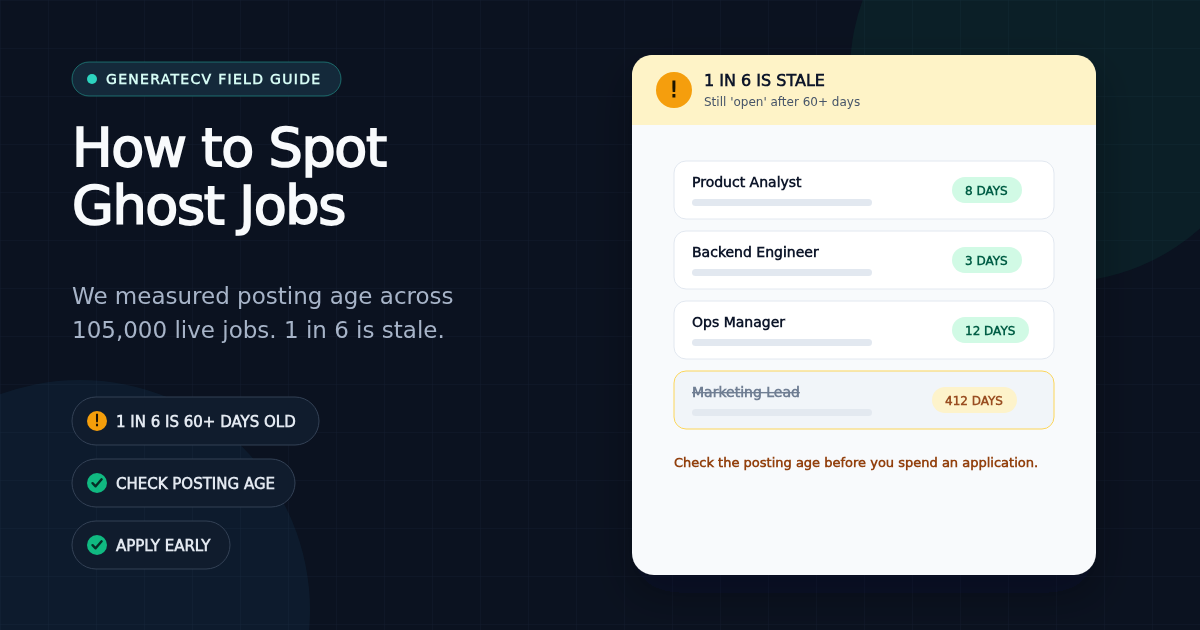
- 16% of 'open' postings across 2,036 company career boards are more than 60 days old; nearly 1 in 10 has been up over 90 days. The oldest posting in our corpus has been accepting applications for over 11 years.
- Ghost rates vary sharply by field: design (21%) and engineering (21%) postings go stale at more than twice the rate of healthcare (9%) — where hiring urgency is real.
- Stale postings are measurably vaguer about money: 60-day-old postings mention compensation ~10 points less often than fresh ones.
- The spotting checklist: posting age over 60 days, no salary figure, vague responsibilities, and the same role reposted repeatedly.
- The rule that follows from the data: postings that really fill do so fast (median 13 days) — put your effort into postings under two weeks old.
Every job seeker knows the feeling: you find a posting that fits, spend an hour tailoring your application, submit — and hear nothing. Ever. Not a rejection. Nothing. For two years, candidates have suspected that many of those postings were never real openings at all. The term that stuck is ghost jobs.
Suspicion is cheap; measurement isn't. Our CareerAgent infrastructure continuously tracks the official career boards of 2,036 companies — 105,015 live postings as of July 14, 2026, read directly from their applicant-tracking systems. Because we see every posting appear, persist, and disappear, we can measure what candidates could only suspect.
The headline numbers
16% of currently-"open" postings — roughly 1 in 6 — have been up for more than 60 days. Nearly 1 in 10 has been up for more than 90. For context: among the 3,010 postings that actually closed during our first month of tracking, the median lifespan was 13 days. The median still-open posting is 17 days old — most of the board is genuinely fresh. But a thick tail never closes: the oldest "open" posting in our corpus has been accepting applications for 4,051 days — a little over 11 years.
That's the two-speed clock we documented in our full 105,000-posting analysis: postings with a real hiring manager behind them fill fast and vanish; the rest calcify into wallpaper. A 70-day-old posting isn't just old — statistically, it has already failed to behave the way real openings behave.
Where ghosts concentrate
Staleness is not evenly distributed. Share of postings older than 60 days, by field:
Design: 21%. Engineering & software: 21%. Sales: 19%. Marketing: 19%. Versus: customer support: 11%. Healthcare: 9%.
The pattern tells you something about hiring intent. Healthcare employers with an open nursing req need a human in the building — postings fill or get pulled. Design and engineering postings, by contrast, are where "evergreen pipeline" hiring lives: roles kept visibly open to collect resumes for a need that is hypothetical, future, or already frozen. If you're a designer or engineer wondering why applications feel like shouting into a void — one in five of the postings you're looking at is, statistically, wallpaper.
Ghosts are cagier about money
One more measurable tell: postings older than 60 days mention compensation about 10 percentage points less often than fresher ones (46% vs 56% in our corpus). It makes sense — a posting nobody intends to fill has no salary band anyone fought for in a budget meeting. Vagueness about money and vagueness about intent travel together.
The spotting checklist
No single signal is proof, but they stack. Before spending an hour on an application, check:
1. Posting age. Over 60 days is the strongest single signal in our data. Many job boards hide posting dates; company career pages (where our data comes from) usually show them, and a Google search of the exact job title + company often reveals when it first appeared.
2. No pay information — especially in states where listing it is legally required. A company ignoring a disclosure law on a posting is telling you how seriously it takes that posting.
3. Vague responsibilities. Real openings are written by a hiring manager who needs specific problems solved. Ghost postings read like a template: "dynamic self-starter," responsibilities that could describe any role at any company.
4. The repost loop. The same role appearing, disappearing, and reappearing every few weeks suggests resume collection, not hiring.
Why this data exists
We track these boards because our CareerAgent only surfaces jobs worth a candidate's time — which means posting freshness is a signal we engineered for, not an afterthought. New postings enter our corpus within hours of appearing on a company's board, inside the 13-day window while the opening is real. And if you just want a fast read on whether one specific job is worth your effort, our free ATS checker takes the posting and your resume and answers honestly — no signup, in your browser.
Ghost jobs aren't a myth, and they aren't a conspiracy either — they're a measurable byproduct of how modern hiring pipelines work. You can't make them disappear. You can stop spending your best hours on them.
Check your resume free — no signup
See what the free text check reads, what it skips, and the first three things to fix — in your browser, no upload.
Related Articles
Who Actually Hires Juniors? 157,622 Live Postings, Counted
We counted every live posting on our job corpus by seniority marker. The entry-level wall is real, but it is wildly uneven by field — and 72% of postings never declare a level at all.
Read articleThe Most In-Demand Skills of 2026, From 102,486 Live Job Postings
We pattern-matched 102,486 live openings on 2,273 company career boards. The most-demanded skills aren't tools: collaboration (61%) and communication (57%) outrank every named technology — Python tops the tool list at 15.6% — and certifications now appear about as often as bachelor's degrees.
Read articleWhat 105,000 Live Job Postings Reveal About the 2026 Job Market
First-party data from 2,036 company career boards: 48% of postings now mention AI, real openings close in a median of 13 days, 1 in 6 'open' jobs is 60+ days old, and senior titles outnumber entry-level 15 to 1.
Read article