What 105,000 Live Job Postings Reveal About the 2026 Job Market
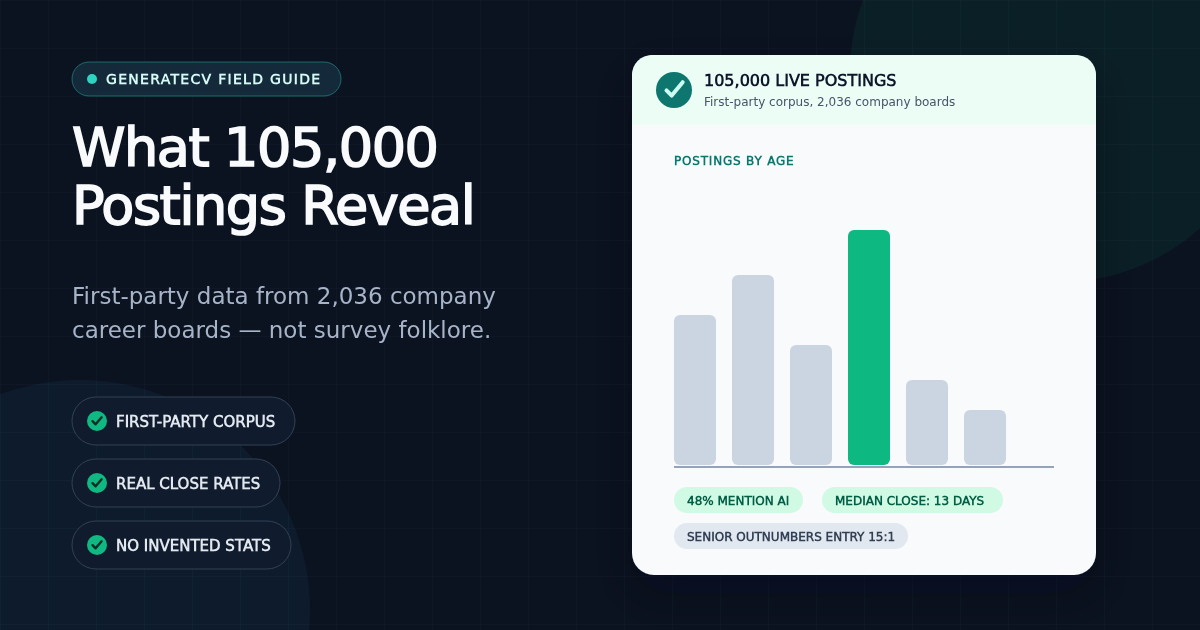
First-party data from 2,036 company career boards: 48% of postings now mention AI, real openings close in a median of 13 days, 1 in 6 'open' jobs is 60+ days old, and senior titles outnumber entry-level 15 to 1.
Key takeaways
- 48% of live job postings now mention AI, machine learning, or LLMs — mentioning how you actually use these tools is no longer optional resume content.
- The market runs on a two-speed clock: postings that closed during our tracking lived a median of just 13 days, while 1 in 6 still-'open' postings is more than 60 days old. Apply in week one; treat two-month-old postings with skepticism.
- The entry-level wall is real and measurable: titles marked senior/staff/principal/lead outnumber titles marked junior/entry/intern by roughly 15 to 1.
- Only 22% of openings are flagged remote — the work-from-anywhere market is a minority market in mid-2026.
- Just 1 in 3 postings lists any pay figure, transparency laws notwithstanding. Research comp independently before you talk numbers.
Most job-market statistics come from surveys — someone asks a few thousand people how the search is going and extrapolates. We wanted the other kind of evidence: what employers are actually posting, right now, on their own career sites. So we measured it.
Our CareerAgent infrastructure continuously watches the official career boards of 2,036 companies — read directly from their applicant-tracking systems (Greenhouse, Ashby, Lever, SmartRecruiters, Workable, Recruitee), not scraped from aggregators, with no duplicate listings and no expired inventory. On July 14, 2026, that corpus held 105,015 live openings. Here is what they say about the market you're actually applying into.
First, the honest fine print
Every stat below is descriptive of this corpus: employers that run modern ATS platforms and post publicly. That skews toward tech-forward companies, though the set deliberately includes healthcare, retail, hospitality, logistics, and finance employers. Seniority is measured by explicit title markers only; AI and salary mentions are detected by pattern-matching the full posting text. It's not a census of the whole labor market — it's a very large, very current, first-party sample. We'd rather tell you exactly what the numbers can and can't say than launder them into universal truths.
Finding 1: Half the market is talking about AI
50,794 of 105,015 live postings — 48% — mention AI, machine learning, or large language models. Not just engineering roles: it shows up in marketing postings ("AI-assisted content workflows"), operations, customer support, sales enablement, HR. In mid-2026, roughly every second job description assumes the technology is part of the work.
What this means for your resume is specific: if you use these tools in your current work — and most professionals now do — that experience belongs on the page, concretely. Not "familiar with AI" (that's the 2024 version), but what you actually do with it: the workflow you automated, the tool you evaluated, the output you quality-control. Half the market is asking. Vague claims read as padding; specific ones read as evidence.
Finding 2: The two-speed clock
This is the finding we haven't seen published anywhere else, and it changes how you should time your applications.
Among the 3,010 postings that closed during our first month of tracking, the median lifespan was 13 days from posted to gone. (Honest caveat: that figure describes postings that closed — long-lived survivors aren't in it.) Meanwhile, of the 105,015 postings still open: 33% have been up for more than 30 days, 16% for more than 60, and nearly 1 in 10 for more than 90.
Put those together and the market has two speeds. Real openings — the ones with a hiring manager actively pulling candidates — tend to fill and vanish inside two weeks. The rest linger: budget-frozen reqs, evergreen pipeline collectors, and the "ghost jobs" candidates have been complaining about for two years, now visible in the data.
Finding 3: The entry-level wall, quantified
Titles carrying senior markers (senior, staff, principal, lead) outnumber titles carrying entry markers (junior, entry, intern, graduate, trainee) by roughly 15 to 1 — 29,958 postings against 1,967. Even granting that many unmarked titles are open to early-career candidates, the explicit signal is stark: employers are overwhelmingly shopping for people who already know the job.
If you're early-career, the data suggests a counterintuitive move: stop filtering by title. The 1,967 explicitly-junior postings are where every other early-career candidate is concentrating, which makes them the most competitive slice of the entire market. The larger opportunity is the unmarked middle — roles whose requirements you may substantially meet even if the title doesn't advertise it. Read requirements, not labels, and judge fit honestly: if you clear 70% of what they ask for and can show evidence, you belong in the pipeline.
Finding 4: Remote is a minority market
22% of live openings — 22,968 postings — are flagged remote. For all the discourse, more than three-quarters of hiring in this corpus names an office. The biggest concentrations: the San Francisco Bay Area and New York (roughly 3,700 live openings each in our corpus), with London (~1,500), Austin, and Singapore following.
The takeaway isn't "remote is dead" — one in five jobs is a lot of jobs. It's that a remote-only search in 2026 competes for a fifth of the market against everyone else running the same filter. If you're near a hub city, hybrid flexibility measurably widens your funnel.
Finding 5: Two-thirds of postings won't tell you the pay
Only 33% of postings — 34,687 of 105,015 — include any salary figure in the posting text, transparency laws in New York, California, and Colorado notwithstanding. The majority of employers still make you apply blind.
Practically: when a posting does list a range, treat it as real negotiating context — companies that publish ranges have usually banded them internally. When it doesn't, research before the first recruiter call, because "what are your salary expectations?" arrives early, and the party with the number has the edge.
What all five findings point to
Read together, the data describes a market that rewards exactly one strategy: fast, honest, well-fitted applications to fresh postings — and punishes everything else. Speed matters because real openings die in two weeks. Fit matters because the entry-level wall and the AI flood mean generic applications drown. And honesty about your actual match matters because effort spent on ghost postings and 15:1 title lotteries is effort stolen from the openings you could genuinely win.
This is, not coincidentally, the shape of the tools we build. Our CareerAgent watches these same 2,000+ company boards continuously, surfaces new postings while they're days old — inside the 13-day window, not after it — and scores each one against your actual resume, gaps included. And if you just want to know whether one specific job is worth your effort, our free ATS checker answers in seconds, no signup, in your browser.
We published the case against mass-applying with the industry data here. This is the companion piece from our own corpus — and we'll re-run these numbers as the market moves. The postings don't lie. Neither should your job search.
Check your resume free — no signup
See what the free text check reads, what it skips, and the first three things to fix — in your browser, no upload.
Related Articles
Who Actually Hires Juniors? 157,622 Live Postings, Counted
We counted every live posting on our job corpus by seniority marker. The entry-level wall is real, but it is wildly uneven by field — and 72% of postings never declare a level at all.
Read articleThe Most In-Demand Skills of 2026, From 102,486 Live Job Postings
We pattern-matched 102,486 live openings on 2,273 company career boards. The most-demanded skills aren't tools: collaboration (61%) and communication (57%) outrank every named technology — Python tops the tool list at 15.6% — and certifications now appear about as often as bachelor's degrees.
Read articleGhost Jobs Are Real: We Measured Them Across 105,000 Live Postings
1 in 6 'open' jobs is more than 60 days old — and the oldest has been accepting applications for 11 years. First-party data on where ghost jobs hide, which fields have the most, and how to spot one before you waste an application.
Read article