Mass-Applying Is Dead: What the 2026 Application Flood Actually Changed
LinkedIn now takes 11,000 applications a minute. Here's what that flood did to your odds, which of the scary statistics about it are real — and why a handful of honestly matched applications now beats a thousand sprayed ones.
Key takeaways
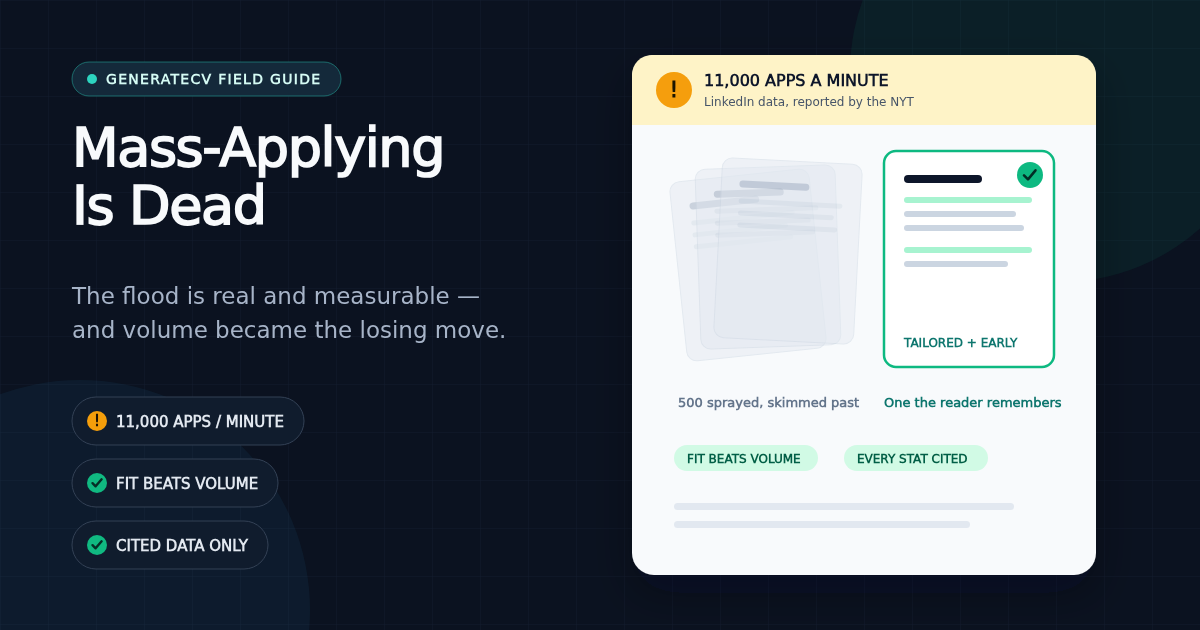
- LinkedIn processes roughly 11,000 job applications a minute, up about 45% in a year — LinkedIn's own data, reported by The New York Times in 2025. The flood is real and measurable.
- Attention per application collapsed with it: eye-tracking research puts a recruiter's initial resume skim at about 7.4 seconds. A generic, mass-generated application cannot survive that skim.
- Many of the scariest mass-applying statistics — precise tailoring multipliers, '0.4% interview rates', 'AI detected in 20 seconds' — don't trace back to any real study. We checked, and we removed the ones we'd repeated.
- A specific, well-researched application works as a costly signal: it proves effort a spray bot can't fake, and recruiters use that as a proxy for seriousness.
- Our own 105,000-posting corpus shows real openings close fast (median 13 days) — so the winning move is a small number of early, honestly matched, genuinely tailored applications.
For two years the pitch was irresistible: point a bot at every job board, let it fire off hundreds of applications while you sleep, and let the law of large numbers do the rest. Spray enough, the logic went, and something has to stick.
In 2026, we can see what actually stuck. It's worth looking at honestly — including being honest about which of the viral statistics on this topic are real — because it changes what a smart job search looks like, and it explains why so many people applying to more jobs are hearing back from fewer.
The flood is real, and it's measurable
LinkedIn processes roughly eleven thousand job applications every minute, an increase of about 45% in a single year. That's not a blogger's guess — it's LinkedIn's own data, reported by The New York Times in mid-2025. The same reporting described an HR consultant who received more than 1,200 applications for one remote role, pulled the posting entirely, and was still sorting through the pile three months later.
That surge isn't more people looking for work. It's the same people, armed with tools that let one person apply to five hundred jobs before lunch. The result is an ocean of applications that all look the same, because they were generated the same way.
Why volume backfires now
The auto-apply era created its own antibodies. Three of them are documented; none of them require a conspiracy theory.
Attention per application collapsed. Recruiters were already fast before the flood: Ladders' eye-tracking study measured the initial resume skim at about 7.4 seconds. Divide a fixed amount of recruiter attention by ten times the applications and the math does the rest. A generic application doesn't get rejected so much as it gets skimmed past — and when every third resume opens with the same synthetic phrasing, the pattern itself reads as low effort.
The screening moved in front of the resume. Employers responded to the flood the way the platforms let them: more knockout questions about authorization, location, licensing, and salary; more role-specific screeners; and, at some companies, a return to live, AI-free assessment stages precisely because the written layer stopped being trustworthy. Note what's not on that list: the ATS itself silently binning you. As we showed in the ATS rejection myth, resume software mostly parses, stores, and searches — the filtering that kills mass applications is configured by humans and answered by you, before your resume is ever read.
The other side automated too. LinkedIn now ships an AI hiring assistant that screens and messages candidates at machine speed. When both sides run models, a generic application gets evaluated twice — once by software checking fit against the posting, once by a human skimming for signal — and it fails the same way both times: nothing in it is specific to the job.
The statistics you'll read elsewhere — and why we won't repeat them
This topic attracts numbers that sound like research and aren't. You'll see claims that tailored resumes convert at exactly "2.1×", that recruiters "detect AI in under 20 seconds", that auto-appliers get "0.4% interview rates", that ATS platforms auto-flag "low-intent" applicants. We went looking for the primary sources behind these. We couldn't find them — the trails end at other blog posts citing each other.
This is the same disease as the famous "75% of resumes are rejected by ATS" myth we've already taken apart: a precise-sounding figure, laundered through repetition, with no study underneath. Our policy on this blog is simple — a number gets a source you can click, or it gets cut. An earlier version of this article repeated some of these figures; we've removed them. The argument against mass-applying doesn't need fake precision, because the mechanism is enough.
What actually works: fit as a costly signal
In a market drowning in low-effort noise, a specific, well-researched application is a costly signal. It proves you spent real effort on this exact role — and recruiters use effort as a proxy for seriousness, because it's the one thing a spray bot can't fake at scale. When everyone can apply to everything, the person who obviously chose you stands out precisely because choosing is expensive.
Our own data adds a second reason: speed. Across the 105,000 live postings we track, real openings close in a median of 13 days — while a sixth of "open" jobs are stale ghost postings that will eat an application and return nothing. The bots spray both kinds equally. A human being — or an honest agent — who checks freshness and fit first applies early to jobs that are actually hiring, which is exactly where a tailored application lands hardest.
So the winning shape of a 2026 job search is almost the inverse of the bot's: fewer applications, sent early, each one genuinely fitted to the role — each one you'd happily defend in the interview it might earn you. The mechanics of doing that honestly are in how to mirror a job description without lying.
The catch — and why most people don't do the thing that works
Tailoring works. It's also slow, which is exactly why people reached for bots in the first place. Reading a posting, figuring out whether you're actually a fit, mirroring its language honestly, and rewriting your resume for it — doing that well, forty times, is a part-time job on top of the one you're trying to leave.
This is the real problem worth solving, and it's a very different problem from "how do I apply to more jobs faster." It's "how do I apply to the right jobs, well, without it eating my life." Those are not the same tool. One optimizes volume. The other optimizes fit — and fit is the only thing the flooded market still rewards.
What we built instead of a spray bot
We build resume tools, and we deliberately did not build an auto-applier — because everything above says it would be selling people a faster way to get skimmed past. We built the opposite.
Our CareerAgent watches real company job boards, ranks openings from your window against your resume, and scores the strongest candidates, gaps included. It'll tell you a job is a 90% fit and show you why; it'll also tell you a job is a 40% fit and show you exactly what you're missing, instead of firing off an application that was never going to land. For the roles worth your time, it prepares a genuinely tailored resume, a cover letter, and honest talking points — and then you decide what gets sent. No spraying, no pretending, no getting lost in the flood.
You can start smaller and free, no signup: paste a job posting and your resume into our ATS checker and see the honest match — which of the role's requirements you hit, which you don't, and whether it's worth applying at all. It's the same principle the flood keeps proving: know the fit before you spend the effort, then spend the effort only where the fit is real.
Mass-applying is dead. Not because applying is dead — because volume stopped being the thing that works, and quietly became the thing that gets you skimmed past. The candidates winning in 2026 aren't the ones sending the most applications. They're the ones sending the right ones.
Updated August 2, 2026: we removed several widely circulated statistics (tailoring multipliers, AI-detection times, auto-applier interview rates) that we could not trace to a primary source, and replaced them with cited or first-party data. That's the same standard we apply to every number on this blog.
Check your resume free — no signup
See how your resume scores against real ATS filters in seconds.
Related Articles
Who Actually Hires Juniors? 157,622 Live Postings, Counted
We counted every live posting on our job corpus by seniority marker. The entry-level wall is real, but it is wildly uneven by field — and 72% of postings never declare a level at all.
Read articleThe Most In-Demand Skills of 2026, From 102,486 Live Job Postings
We pattern-matched 102,486 live openings on 2,273 company career boards. The most-demanded skills aren't tools: collaboration (61%) and communication (57%) outrank every named technology — Python tops the tool list at 15.6% — and certifications now appear about as often as bachelor's degrees.
Read articleWhat 105,000 Live Job Postings Reveal About the 2026 Job Market
First-party data from 2,036 company career boards: 48% of postings now mention AI, real openings close in a median of 13 days, 1 in 6 'open' jobs is 60+ days old, and senior titles outnumber entry-level 15 to 1.
Read article