The Most In-Demand Skills of 2026, From 102,486 Live Job Postings
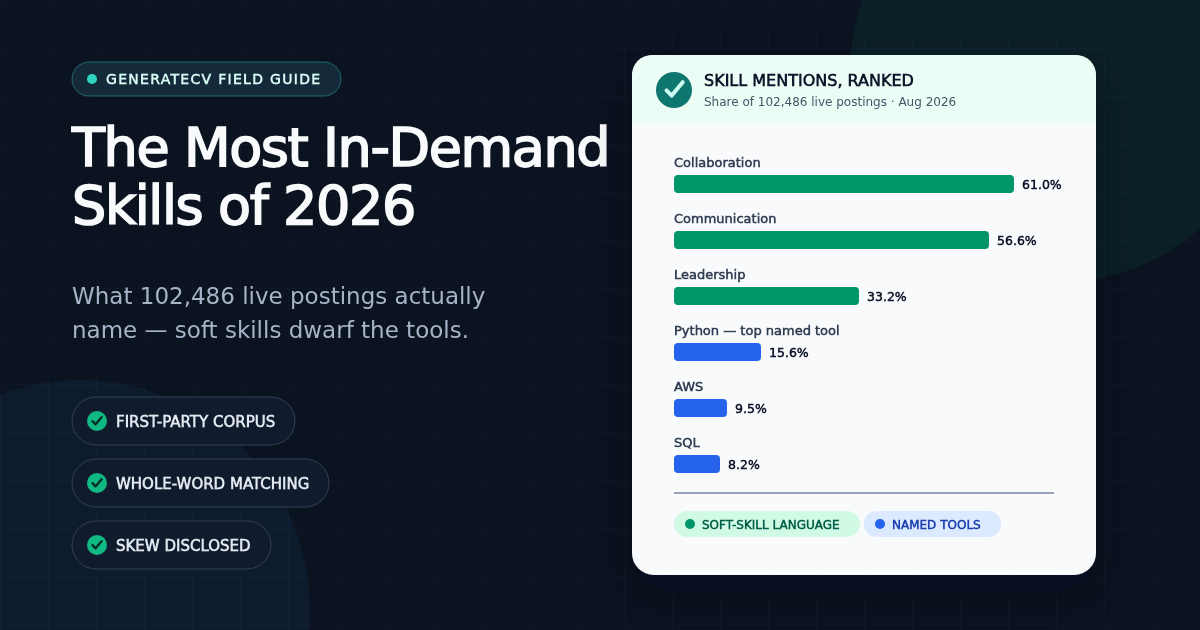
We pattern-matched 102,486 live openings on 2,273 company career boards. The most-demanded skills aren't tools: collaboration (61%) and communication (57%) outrank every named technology — Python tops the tool list at 15.6% — and certifications now appear about as often as bachelor's degrees.
Key takeaways
- The most in-demand skills aren't tools: collaboration language appears in 61.0% of live postings and communication in 56.6% — roughly four times the top named technology.
- Python is the most-named hard skill at just 15.6%, followed by AWS (9.5%) and SQL (8.2%). No single tool comes close to half the market — mirror each job description instead of chasing a universal list.
- The AI stack has reshuffled: 'LLM' (6.5%) now outnumbers 'machine learning' (5.7%) in posting text, PyTorch leads TensorFlow, and 'prompt engineering' already appears as often as SAP.
- Only 22.7% of postings mention a bachelor's degree, while 53.4% specify years of experience and 24.3% mention certifications — experience and certs are the visible gates now.
- Salesforce (7.0%) is the most-demanded business platform, ahead of Docker, React, and every design or BI tool in the corpus.
Every January the internet fills with "top 10 skills employers want" lists, and almost none of them say where the numbers come from. We can do better, because we have the postings themselves. Our CareerAgent infrastructure continuously reads the official career boards of 2,273 companies — directly from their applicant-tracking systems (Greenhouse, Ashby, Lever, SmartRecruiters, Workable, Recruitee), not from aggregators. On August 5, 2026, that corpus held 102,486 live openings. We pattern-matched all of them to answer one question: which skills do employers actually name?
The fine print, before the findings
Method: case-insensitive whole-word matching against the full text of every open posting, at a single snapshot. That design has known edges, and you should read the numbers with them in mind. A mention is not a formal requirement — "you'll collaborate with design" counts toward collaboration. Whole-word matching keeps "Java" from matching "JavaScript", but a word like "React" can occasionally be the verb rather than the framework. We match Excel strictly ("Microsoft Excel" / "MS Excel") because bare "excel" is usually the verb, so that figure undercounts. And the corpus itself skews toward companies that run modern ATS platforms — tech-forward employers are overrepresented, so tool percentages read higher here than in the economy at large. The soft-skill findings are the robust ones; they dominate by margins no skew explains away.
Finding 1: the most in-demand skills aren't tools
Rank everything we matched — every language, platform, and framework — and the top of the list isn't a technology at all:
| Language in postings | Share of postings | Postings |
|---|---|---|
| Collaboration | 61.0% | 62,549 |
| Communication | 56.6% | 57,970 |
| Leadership | 33.2% | 33,982 |
| Stakeholders | 29.4% | 30,113 |
| Cross-functional | 28.6% | 29,355 |
| Mentoring | 19.3% | 19,801 |
| Problem-solving | 15.2% | 15,623 |
| Attention to detail | 13.6% | 13,950 |
| Project management | 6.5% | 6,619 |
Collaboration language appears in 61.0% of live postings and communication in 56.6% — roughly four times the most-demanded named technology. This is not a reason to type the word "collaborative" into your skills section; recruiters skim adjectives. It's a reason to make your bullets carry the evidence: who you worked across teams with, what you communicated to whom, what the outcome was. We've written about what makes recruiters skip bullets — vague soft-skill claims top the list, while specific cross-team results are exactly what 28.6% of postings are asking for when they say "cross-functional".
Finding 2: the named-tool league table has a long tail
| Named tool / technology | Share of postings | Postings |
|---|---|---|
| Python | 15.6% | 15,941 |
| AWS | 9.5% | 9,707 |
| SQL (standalone) | 8.2% | 8,407 |
| Salesforce | 7.0% | 7,161 |
| LLMs / large language models | 6.5% | 6,695 |
| Google Cloud / GCP | 6.2% | 6,318 |
| Kubernetes | 6.0% | 6,108 |
| Machine learning | 5.7% | 5,841 |
| Azure | 5.3% | 5,452 |
| Java | 4.2% | 4,286 |
| Linux | 4.1% | 4,159 |
| TypeScript | 4.1% | 4,158 |
| React | 3.9% | 3,949 |
| Docker | 3.7% | 3,792 |
| Generative AI | 3.4% | 3,515 |
Python is the most-named hard skill in the corpus — and it appears in just 15.6% of postings. AWS follows at 9.5%, standalone SQL at 8.2%. Nothing else clears one posting in ten. That long tail is the practical finding: there is no fixed skill list that covers even a fifth of the market, which means the winning move isn't memorizing a top-10 — it's mirroring the specific posting you're applying to, in its own vocabulary.
Two smaller notes from the table. TypeScript (4.1%) now out-mentions JavaScript (3.0%) in posting text. And Salesforce, at 7.0%, is the highest-ranked business platform in the entire corpus — ahead of Docker, React, and every design or BI tool we matched. If your work touches a CRM, naming it is not filler; it's the fourth-most-demanded tool on the board.
Finding 3: the AI stack reshuffled
Our July corpus report measured the umbrella: roughly half of postings mention AI, machine learning, or LLMs somewhere. The skills view shows what's moving underneath. "LLM" or "large language model" now appears in 6.5% of postings — more than "machine learning" at 5.7%. The generic era's flagship term has been passed by its successor. Meanwhile PyTorch (1.4%) leads TensorFlow (0.9%) — the framework race that defined 2019 job ads has a verdict — and "prompt engineering", a phrase that barely existed three years ago, already appears in 1.5% of postings, as often as SAP.
For your resume: name the layer you actually work at. "Built evaluation harness for LLM outputs" or "automated triage with a fine-tuned model" beats "AI experience" in both the 6.5% of postings that ask for LLM work specifically and the half of the market that mentions AI at all.
Finding 4: degrees are fading from the text; experience isn't
Only 22.7% of postings mention a bachelor's degree. More than three-quarters of live openings in this corpus don't name one. What they name instead: 53.4% specify years of experience, and 24.3% mention certifications — which means certifications now appear in posting text about as often as bachelor's degrees. Master's degrees and MBAs trail far behind at 3.2%.
Read this carefully rather than triumphantly: plenty of employers still assume a degree without typing it, and a mention isn't always a hard requirement in either direction. But the visible gate has moved. If you're weighing a certification against a return to school, the posting text says the certificate reaches parity in employer language at a fraction of the cost — and if you don't have a degree, the 22.7% figure is permission to stop self-rejecting from the other three-quarters of the market.
What to do with all of this
Three moves, in order. First, put your evidence where the demand is: bullets that show collaboration, communication, and cross-functional results — with names, numbers, and outcomes — serve the language that appears in six postings out of ten. Second, stop maintaining one universal skills list; the named-tool table's long tail means the high-leverage act is matching each posting's specific vocabulary, which takes minutes with the posting open. Third, if you work with AI at any layer, say which layer, in the market's current terms.
We'll re-run this battery as the corpus grows and publish what changes, including the numbers that move against us. The queries are versioned alongside the article — same corpus, same patterns, next snapshot. If you want the market's other clock — how fast real openings close and how many "open" postings are ghosts — that's in the companion corpus report.
Check your resume free — no signup
See how your resume scores against real ATS filters in seconds.
Related Articles
Who Actually Hires Juniors? 157,622 Live Postings, Counted
We counted every live posting on our job corpus by seniority marker. The entry-level wall is real, but it is wildly uneven by field — and 72% of postings never declare a level at all.
Read articleWhat 105,000 Live Job Postings Reveal About the 2026 Job Market
First-party data from 2,036 company career boards: 48% of postings now mention AI, real openings close in a median of 13 days, 1 in 6 'open' jobs is 60+ days old, and senior titles outnumber entry-level 15 to 1.
Read articleGhost Jobs Are Real: We Measured Them Across 105,000 Live Postings
1 in 6 'open' jobs is more than 60 days old — and the oldest has been accepting applications for 11 years. First-party data on where ghost jobs hide, which fields have the most, and how to spot one before you waste an application.
Read article