Do Pay Transparency Laws Actually Work? 105,000 Job Postings Say Yes — With a Catch
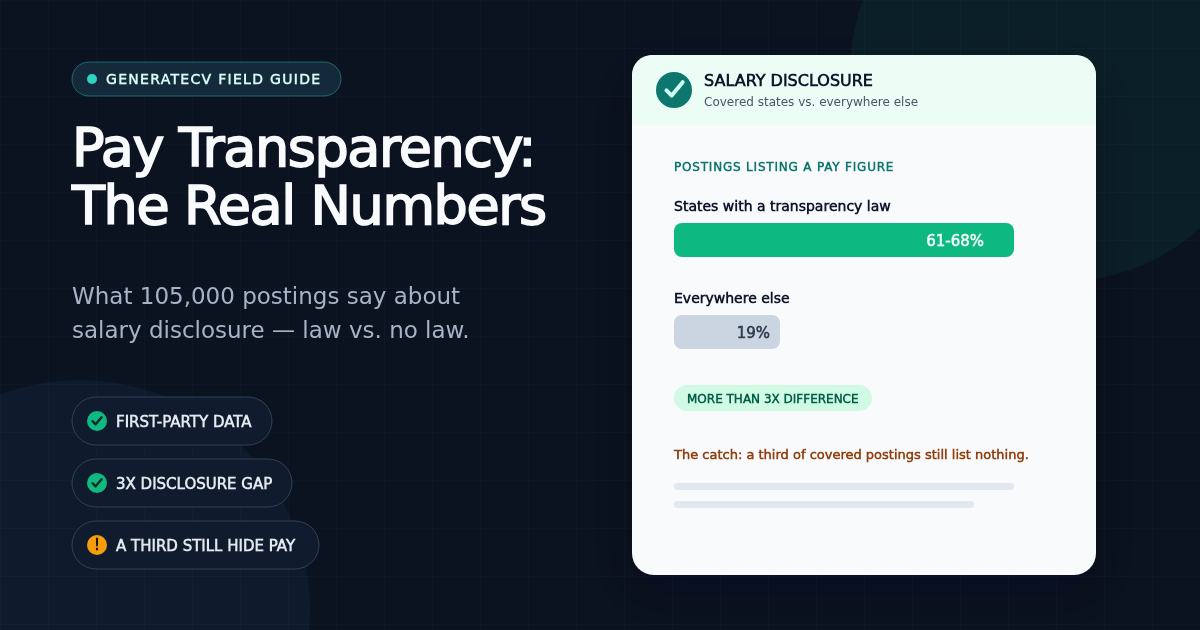
First-party data across 2,036 company career boards: salary disclosure runs 61–68% in states with transparency laws versus 19% everywhere else — a 3x difference. The catch: a third of postings in covered states still list nothing.
Key takeaways
- Pay transparency laws work: 61–68% of postings in covered locations (CA, NY, WA, CO) list a pay figure versus just 19% in locations without a law — a more than 3x difference.
- The catch: roughly a third of postings in law-covered states still publish no number, years after the mandates took effect.
- Remote postings sit in between at 33% disclosure — many fall under state laws in theory, but enforcement ambiguity shows in the data.
- Across the whole market, only 1 in 3 postings lists any pay figure at all.
- Practical rule: treat a published range as real negotiating context; treat silence as a signal to research comp before the first recruiter call.
Since 2021, a wave of US states — Colorado first, then California, New York, Washington, and others — passed laws requiring employers to publish salary ranges in job postings. The promise: less pay-gap opacity, more negotiating power for candidates. The question nobody can easily answer from surveys: do employers actually comply?
We can measure it. Our CareerAgent infrastructure tracks 105,015 live postings on the official career boards of 2,036 companies — read directly from their applicant-tracking systems. We checked every posting's text for a salary figure and grouped by posting location. Snapshot: July 14, 2026.
The numbers
Share of postings listing a pay figure, by posting location:
Colorado: 68%. Washington: 68%. New York: 64%. California: 61%.
Remote-flagged postings: 33%.
Locations with no transparency law: 19%.
The laws more than triple disclosure. Where legislators acted, candidates see numbers; where they didn't, four postings out of five are silent about money. This is one of the clearest natural experiments in hiring policy, and the effect size is unambiguous.
The catch
Read the same numbers from the other side: roughly a third of postings in law-covered states still publish no pay figure — years after the mandates took effect, with penalties on the books. Some of that gap is edge cases (exempt employer sizes, roles technically outside a law's scope, ranges buried in application forms rather than posting text). But a meaningful share is simple non-compliance that goes unenforced.
The in-between number is just as telling: remote postings disclose at 33% — halfway between law-state and no-law rates. In theory, many remote roles hireable in California or Colorado fall under those states' laws. In practice, the ambiguity about which law applies to a location-less posting shows up directly in the data: employers disclose when a specific law clearly points at them, and hedge when it doesn't.
What to do with this as a candidate
When a range is published, treat it as real. Companies that publish ranges have usually banded them internally — the top of a published range is a defensible ask if your experience supports it, not a fantasy number.
When there's no number, come armed. "What are your salary expectations?" arrives in the first call, and the party holding a number negotiates better than the party guessing. Use published ranges from comparable law-state postings for the same title — that's the transparency laws working for you even when your target company ignores them.
Factor silence into fit. A posting in a law-covered state with no range is telling you something about how that employer treats obligations when nobody's checking. It doesn't disqualify the job; it belongs in your read of the company.
Methodology, honestly
Corpus: 105,015 live postings on 2,036 company career boards (Greenhouse, Ashby, Lever, SmartRecruiters, Workable, Recruitee), July 14, 2026. Detection: pattern-matching for salary figures in posting text — postings that disclose pay only inside application forms are counted as non-disclosing, so true disclosure may run slightly higher everywhere; the between-state comparison is unaffected. Location grouping is by posting-location string, which is imperfect for multi-state employers. The corpus skews toward companies on modern ATS platforms. Full corpus findings are in What 105,000 Live Job Postings Reveal.
We publish this data because our whole product thesis is that candidates deserve the truth about their odds — CareerAgent scores real postings against your actual resume, gaps included, and our free ATS checker does it for any single job in seconds, no signup. Transparency isn't just good policy. It's a strategy.
Check your resume free — no signup
See what the free text check reads, what it skips, and the first three things to fix — in your browser, no upload.
Related Articles
Who Actually Hires Juniors? 157,622 Live Postings, Counted
We counted every live posting on our job corpus by seniority marker. The entry-level wall is real, but it is wildly uneven by field — and 72% of postings never declare a level at all.
Read articleThe Most In-Demand Skills of 2026, From 102,486 Live Job Postings
We pattern-matched 102,486 live openings on 2,273 company career boards. The most-demanded skills aren't tools: collaboration (61%) and communication (57%) outrank every named technology — Python tops the tool list at 15.6% — and certifications now appear about as often as bachelor's degrees.
Read articleWhat 105,000 Live Job Postings Reveal About the 2026 Job Market
First-party data from 2,036 company career boards: 48% of postings now mention AI, real openings close in a median of 13 days, 1 in 6 'open' jobs is 60+ days old, and senior titles outnumber entry-level 15 to 1.
Read article