Cover Letter Length: The One-Page Editing Guide
Use a practical 250-to-400-word cover letter range, assign space to proof instead of filler, and trim an overlong draft with a paragraph-by-paragraph editing method.
Key takeaways
- One page is the editing boundary; 250-400 words is a useful default range, not a hiring statistic or universal software rule.
- Spend most of the page on one or two evidence paragraphs that connect the posting's priorities to your real work.
- A shorter letter can be complete when the application asks for a note, the resume already makes the fit obvious, or your strongest proof needs little context.
- Trim repeated resume history, generic company praise, throat-clearing, and adjectives before you remove evidence.
- Readable type, normal margins, short paragraphs, and the requested file format matter more than forcing a precise word count.
Keep a standard cover letter to one page, usually 250 to 400 words. Treat that range as an editorial default, not a hiring statistic and not a rule enforced by every application system. The real test is whether one page can make one focused argument: this role needs X, your experience proves X, and this is why the match deserves a conversation.
The complete structure lives in our how to write a cover letter guide. This article solves the narrower problem: how much space each part gets, when shorter is better, and what to cut when a draft spills onto page two.
The useful answer: one page, not one magic count
Page count and word count solve different problems. One page controls the reader's experience: the whole argument is visible as a single document. A word range controls density: enough room for proof, not enough room for an autobiography. A 320-word letter can still feel long if it is one wall of text; a 410-word letter can fit on one page only by shrinking the type until the layout becomes hostile.
Use normal document settings first. Then edit the words to fit. Do not solve excess length with 9-point text, narrow line spacing, tiny margins, or a header that crowds the body.
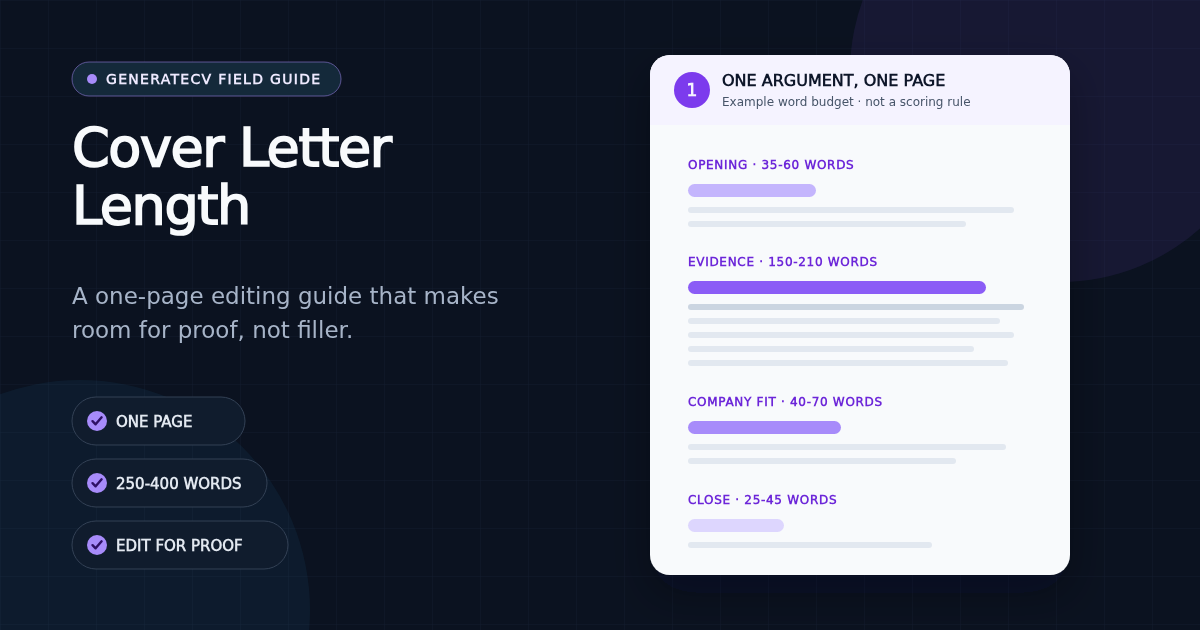
A paragraph budget that lands near 300 words
| Part | Working budget | What earns the space |
|---|---|---|
| Greeting + opening | 35-60 words | Exact role, top requirement, strongest relevant proof |
| Evidence paragraph 1 | 80-110 words | One requirement mapped to one concrete example |
| Evidence paragraph 2 or company fit | 70-100 words | A second proof or specific reason this environment fits |
| Close | 25-45 words | Plain intent, relevant contribution, thanks, name |
These are editing allocations, not external benchmarks. Shift the space toward the strongest evidence. A career changer may need two evidence paragraphs to explain the bridge. A candidate whose resume already mirrors the role may need only one. The company paragraph never deserves space simply because templates include one.
When a cover letter should be shorter
A complete letter can sit below the default range when:
- The application asks for a short note, message, or statement rather than a formal letter.
- The posting gives a specific word or character limit. Follow the posting.
- Your role match is direct and one strong example makes the case without explanation.
- You are sending an email whose subject and signature already carry some of the document framing.
- The employer asks one or more separate application questions that already collect motivation or company-fit context.
Short does not mean generic. A 180-word note still needs role, proof, fit, and a close. It simply uses one evidence example instead of two.
When you may need the upper end of the range
Use more of the page when context changes how the resume should be read: a career change, a return after a break, a move from contract to permanent work, or an unusual combination of domain and technical experience. The extra words should resolve the ambiguity, not rehearse every job.
If the application requests a detailed statement against selection criteria, research narrative, teaching statement, or another named document, that is not a normal cover letter. Follow the stated instructions even when the result exceeds one page. The document type changed, so the cover-letter default no longer controls it.
How to cut a long cover letter
1. Delete the resume replay
Remove the paragraph that walks job by job through your chronology. The reader already has the resume. Keep only the one or two episodes that prove the posting's highest-priority requirements.
2. Cut throat-clearing
"I am writing to express my sincere interest in applying for the open position" spends the first line restating the application event. Name the role and move immediately to proof.
3. Run the swap-the-logo test
Delete company praise that would survive unchanged if you replaced the employer's name. "I admire your innovative culture" is not research. A product, operating problem, customer group, or stated priority can be.
4. Keep the fact, cut the adjective
"I am a highly analytical and results-oriented operations professional" can become a specific operating result. Evidence is usually shorter because it does not need self-endorsement.
5. Remove repeated conclusions
If an example already proves that you can lead a rollout, the next sentence does not need to say, "This demonstrates my strong rollout leadership." Spend that line on the fit or remove it.
Worked edit: 118 words down to 62
The passages below are fictional teaching examples, not a real applicant, employer, or institution.
Before: I am writing to express my sincere interest in the Product Operations Manager role. With my extensive professional background and proven track record, I believe I would be a strong fit for this exciting opportunity. In my current role, I am responsible for many aspects of product operations, including launches, reporting, stakeholder communication, and process improvement. I am highly organized, detail-oriented, and passionate about helping cross-functional teams succeed. One of my recent projects involved improving our launch process, and this experience demonstrates that I possess the skills and qualities listed in your job description. I would be thrilled to bring my experience to your innovative team.
After: Your Product Operations Manager role needs someone who can make cross-functional launches predictable. I rebuilt a 7-team readiness process around named owners and 46 acceptance checks, moving the next release 2 weeks ahead of its approved baseline. I would bring that same operating discipline to your planned self-serve rollout, where clear handoffs between product, support, and revenue teams will matter.
The shorter version preserves role, proof, mechanism, and company fit. It cuts only ceremony, duties, unsupported traits, and the sentence explaining what the evidence already shows.
How long should each paragraph look?
Use three to five short paragraphs. Most should be two to four sentences, with a visible break between opening, evidence, fit, and close. This is a reading aid, not an invitation to turn every sentence into its own paragraph.
- Opening: one compact paragraph.
- Evidence: one or two paragraphs, each built around one requirement-to-proof link.
- Company fit: often two sentences; merge it into the second evidence paragraph when that reads naturally.
- Close: one or two sentences, then your name.
Layout checks before you cut more words
- Use the same name and contact header as the resume when practical.
- Keep a readable body size and conventional margins.
- Use normal line spacing with visible paragraph breaks.
- Name the file clearly, such as
firstname-lastname-cover-letter.pdf. - Follow the requested file type and confirm the exported text is selectable.
- Open the final file once outside your editor and inspect the last line, page count, and links.
The file and parsing questions are separate from the argument. Our cover letter ATS myths guide explains what upload and extraction guidance can support, while the ATS-friendly resume format guide is the canonical checklist for readable document structure.
Final length test
- Does the posting give a limit? Follow it.
- Does the draft fit on one readable page without layout tricks?
- Is most of the space attached to evidence rather than introduction or praise?
- Does each paragraph add a new part of the argument?
- Could you remove another sentence without losing proof or necessary context?
Stop when the letter is complete, not when a counter reaches a magic number. One page and 250-400 words are useful pressure: they force selection. The quality comes from what survives the cut.
Draft your cover letter in minutes
Paste the job description, add your resume, and get a tailored letter you can edit line by line — built on your real experience, never invented.
Related Articles
Cover Letter ATS Myths: What Parsing Actually Does
Separate upload and text-extraction reality from cover-letter ATS folklore: file formats, keywords, hidden text, columns, length, and a parsing-safe checklist.
Read articleHow to Write a Cover Letter That Actually Gets Read: Format, Example & Checklist
Most cover letters restate the resume in paragraph form and open with 'I am writing to express my interest…'. Here's the format that survives a skim, a copyable four-part structure, a real before-and-after opening, and the honest way to use AI without letting it invent your story.
Read articleHow Our Free Resume Checker Calculates Its Score
The category weights, extracted-text checks and limitations behind GenerateCV's local resume report.
Read article