Why Our ATS Checker Is Free, Unlimited, and Doesn't Want Your Email
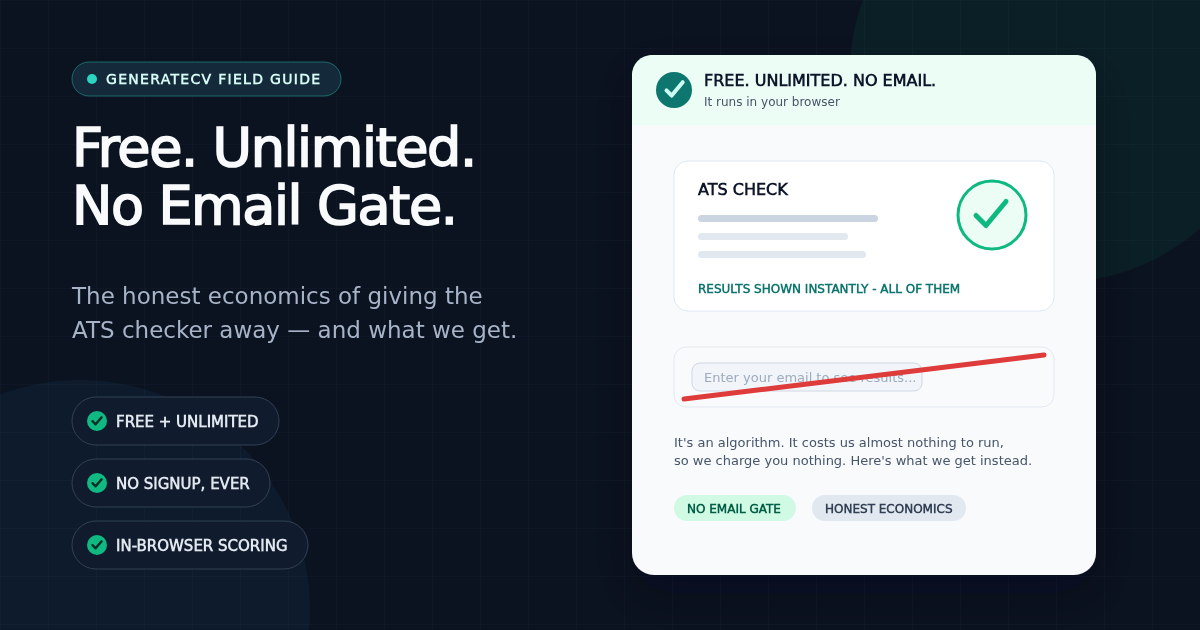
It's just an algorithm — it costs us almost nothing to run, so we charge you nothing. Here's the honest economics of resume-tool paywalls, and exactly what we get out of giving this away.
Key takeaways
- Most ATS checkers gate results behind email signups or subscriptions priced at $25–50/month.
- Ours runs entirely in your browser — your resume never uploads, so an extra scan costs us nothing.
- Free tools are still marketing. We explain exactly how ours works instead of pretending otherwise.
- When we do charge (optional AI features), it's a one-time pass — no auto-renewing subscription.
If you've shopped around for an ATS resume checker, you know the drill: upload your resume, watch a progress bar build suspense, and then — right before the results — a wall. Enter your email. Start a trial. Subscribe for somewhere between $25 and $50 a month to see what a piece of software thinks of your formatting.
Ours doesn't do that. No account, no email, no scan limit. And because "free" on the internet usually means "you're the product," we'd rather explain the economics plainly than let you wonder.
The honest cost structure: it's just an algorithm
Our checker's core analysis runs entirely in your browser. When you upload a PDF, the text is extracted on your device, scored on your device, and displayed on your device. Your resume never reaches our servers for the free analysis. Which means your hundredth scan costs us exactly what your first one did: nothing.
Paywalling something with zero marginal cost isn't covering expenses — it's a toll booth. The subscription checkers aren't charging you because scans are expensive. They're charging you because you're anxious, you're mid-job-search, and a $2.95 "trial" that quietly renews at full price next month is a proven business model. The industry even has a quiet dependency on you forgetting to cancel — job searches end, subscriptions don't.
What we get out of it (yes, there's something)
Free tools are still marketing. Here's exactly how ours works, no pretending:
- You scan your resume. The results show you real, specific problems — parsing issues, missing keywords, weak bullets.
- Next to those problems is a button that offers to fix them in our resume builder. Also free to use.
- Somewhere down the line, if you want our heavier AI features beyond the free daily allowance, we'll offer a paid option. That's the business.
The checker is the front door, not the product. Canva made templates free and sold the workspace; we make the checkup free and offer the treatment. The difference between this and the email-wall model is that you get full value before any transaction is even mentioned — and if you take your improved resume and never come back, that's a perfectly acceptable outcome to us. Genuinely.
Why no email, though? Even free tools collect emails.
Because an email wall changes what the tool is. The moment results require an address, every design decision afterward bends toward the mailing list — scarier scores to justify the "fix it" emails, vaguer findings to keep you dependent. We'd rather the checker compete on being right. If our results are useful, you'll remember where you got them. If they aren't, no drip campaign should drag you back.
And when we do charge?
One-time passes sized to a job search — not a subscription engineered to outlive one. A job hunt lasts a few months; billing that quietly continues past it isn't a pricing model, it's a bet against your attention. We're not taking that bet. When our paid tier ships, it will end on its own, on purpose.
That's the whole pitch, honestly stated: scan your resume free, keep the findings either way, and pay us only if the heavier tools are worth it to you. An algorithm shouldn't cost $50 a month, and your anxiety shouldn't be anyone's business model.
Check your resume free — no signup
See how your resume scores against real ATS filters in seconds.
Related Articles
Who Actually Hires Juniors? 157,622 Live Postings, Counted
We counted every live posting on our job corpus by seniority marker. The entry-level wall is real, but it is wildly uneven by field — and 72% of postings never declare a level at all.
Read articleThe Most In-Demand Skills of 2026, From 102,486 Live Job Postings
We pattern-matched 102,486 live openings on 2,273 company career boards. The most-demanded skills aren't tools: collaboration (61%) and communication (57%) outrank every named technology — Python tops the tool list at 15.6% — and certifications now appear about as often as bachelor's degrees.
Read articleWhat 105,000 Live Job Postings Reveal About the 2026 Job Market
First-party data from 2,036 company career boards: 48% of postings now mention AI, real openings close in a median of 13 days, 1 in 6 'open' jobs is 60+ days old, and senior titles outnumber entry-level 15 to 1.
Read article