What Resume Builders Actually Cost in 2026
The sticker price is rarely the price. A plain-English breakdown of what Zety, Teal, Rezi, and Kickresume really charge — the auto-renewal traps, weekly-billing math, and download paywalls — and the four questions to ask before you enter a card.
Key takeaways
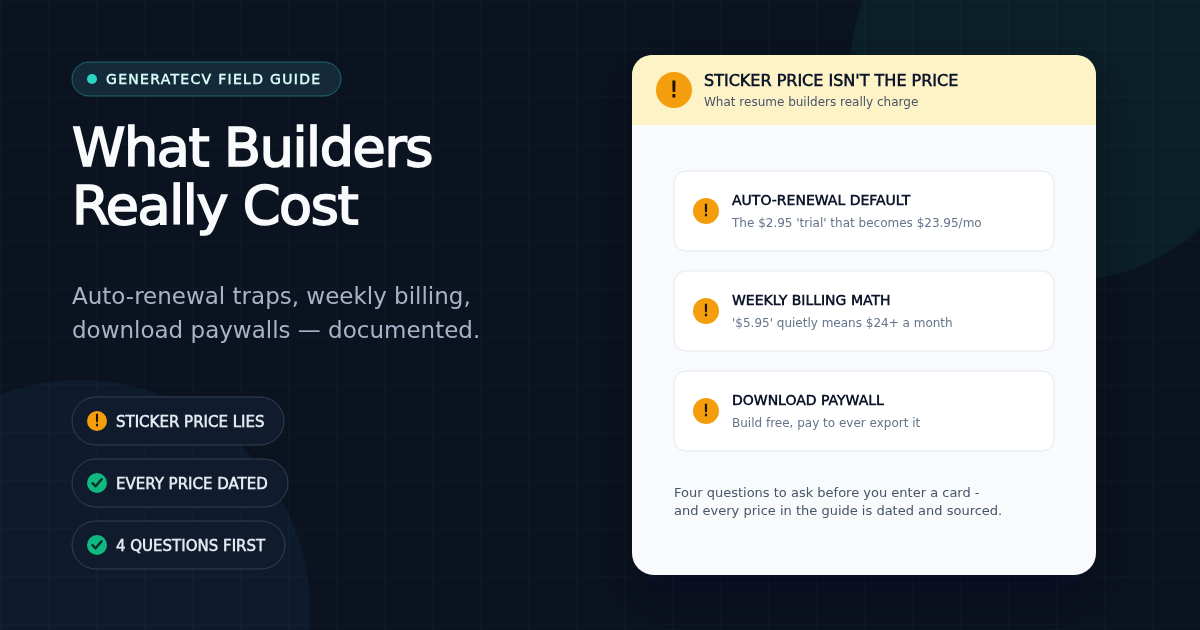
- Resume builder pricing runs on four patterns: download paywalls, weekly billing, auto-renewal defaults, and 'free' tiers with lifetime caps.
- Weekly pricing is the one to do math on: a $13/week plan left running costs more than $650 a year.
- A job search is episodic — weeks, not years — so subscriptions on resume tools mostly monetize forgetting to cancel.
- Before entering a card anywhere, ask: can I export for free, does it auto-renew, what does 'free' actually cap, and what happens to my documents when I stop paying?
- Listed prices change — always check the vendor's own pricing page. The prices here were the listed rates as of July 2026.
If you've ever searched "is Zety free" or found a $23.70 charge you don't remember agreeing to, this article is for you. Resume builder pricing isn't complicated because the products are complicated — it's complicated because the sticker price is rarely the price. Here's how the major tools actually charge in 2026, and the four patterns to watch for anywhere you're asked for a card.
One honest caveat up front: listed prices change, and funnels vary by region and promotion. Everything below reflects the vendors' listed rates as of July 2026 — always confirm on their own pricing pages.
Pattern one: the download paywall
The classic. You spend forty-five minutes building a resume for free, hit "Download," and meet the paywall — priced exactly at the moment your sunk cost peaks. Zety is the best-known example: building is free, but leaving with your document isn't, and the low intro price converts into a recurring subscription that renews roughly every four weeks until cancelled. The model works precisely because walking away from forty-five minutes of work feels worse than paying.
Pattern two: weekly billing
A small number, billed often. Teal's premium tier lists at $13 per week (with $29/month and $79/quarter options). Thirteen dollars reads like lunch money, but weekly billing means fifty-two renewals a year — left running, that plan costs more than $650 annually, which is more than many professional human resume writers charge. Weekly pricing exists because nobody multiplies by fifty-two at checkout.
Pattern three: auto-renewal on an episodic product
Here's the structural problem with every subscription in this category: a job search is episodic. It lasts weeks or months, then it ends — ideally because you got hired. A subscription keeps billing after the reason you bought it is gone, which means a meaningful slice of this industry's revenue is people who forgot to cancel. That's not a bug in their pricing; for some vendors it's the business model.
Pattern four: "free" with lifetime caps
Free tiers deserve fine-print reading too. Rezi's free plan, for example, allows one resume and up to three PDF downloads — total, ever — with paid plans at $29/month or a $149 lifetime purchase. Kickresume's free tier is more usable (four templates, unlimited downloads) with premium at $24/month or $96/year. A free tier with a lifetime cap isn't free; it's a demo with homework.
The going rates, side by side
As of July 2026, listed prices:
| Tool | Free tier reality | Paid | Billing model |
|---|---|---|---|
| Zety | Build free, pay to download | Low intro, then recurring | Auto-renews ~every 4 weeks |
| Teal | Solid tracker; AI credits are one-time | $13/wk · $29/mo · $79/qtr | Auto-renewing subscription |
| Rezi | 1 resume, 3 PDF downloads lifetime | $29/mo · $149 lifetime | Subscription or one-time |
| Kickresume | 4 templates, unlimited downloads | $24/mo · $96/yr | Auto-renewing subscription |
| GenerateCV | Full builder, all templates, PDF + DOCX export, daily AI allowance | $14/30 days · $29/90 days | One-time — no auto-renew |
What fair pricing looks like for a job search
We obviously have a position here, so let's state it plainly rather than pretend neutrality. We think a resume tool should charge the way a job search works: the core product free with no download hostage, and when you're in an aggressive stretch of applying — tailoring a resume and cover letter to every posting — a one-time pass that covers the sprint and then simply ends. That's why GenerateCV's Pro Pass is $14 for 30 days or $29 for 90, no subscription, nothing to remember to cancel, with a 7-day no-questions refund. If we only earn money when someone is actively job hunting, our incentives point at getting you hired — not at your forgetfulness.
Four questions before you enter a card anywhere
- Can I export my finished resume without paying? If no, everything before the paywall was bait.
- Does it auto-renew, and how often? Multiply weekly prices by 4.3. Find the cancel flow before you buy.
- What does "free" actually cap? Per day, per month, or per lifetime — the difference between a usable tier and a demo.
- What happens to my documents if I stop paying? Your work history is yours. Any tool that disagrees is the wrong tool.
Whatever you choose — including us — choose it with the math done and the renewal terms read. A resume builder should cost you a little money once, not a subscription you discover in month four.
Check your resume free — no signup
See how your resume scores against real ATS filters in seconds.
Related Articles
Who Actually Hires Juniors? 157,622 Live Postings, Counted
We counted every live posting on our job corpus by seniority marker. The entry-level wall is real, but it is wildly uneven by field — and 72% of postings never declare a level at all.
Read articleThe Most In-Demand Skills of 2026, From 102,486 Live Job Postings
We pattern-matched 102,486 live openings on 2,273 company career boards. The most-demanded skills aren't tools: collaboration (61%) and communication (57%) outrank every named technology — Python tops the tool list at 15.6% — and certifications now appear about as often as bachelor's degrees.
Read articleWhat 105,000 Live Job Postings Reveal About the 2026 Job Market
First-party data from 2,036 company career boards: 48% of postings now mention AI, real openings close in a median of 13 days, 1 in 6 'open' jobs is 60+ days old, and senior titles outnumber entry-level 15 to 1.
Read article