AI Resume Builder vs. Professional Resume Writer: The 2026 Guide
AI resume builders and professional writers both promise a better resume. Here's an honest 2026 comparison of cost, turnaround, and ATS effectiveness — and when each one actually wins.
Key takeaways
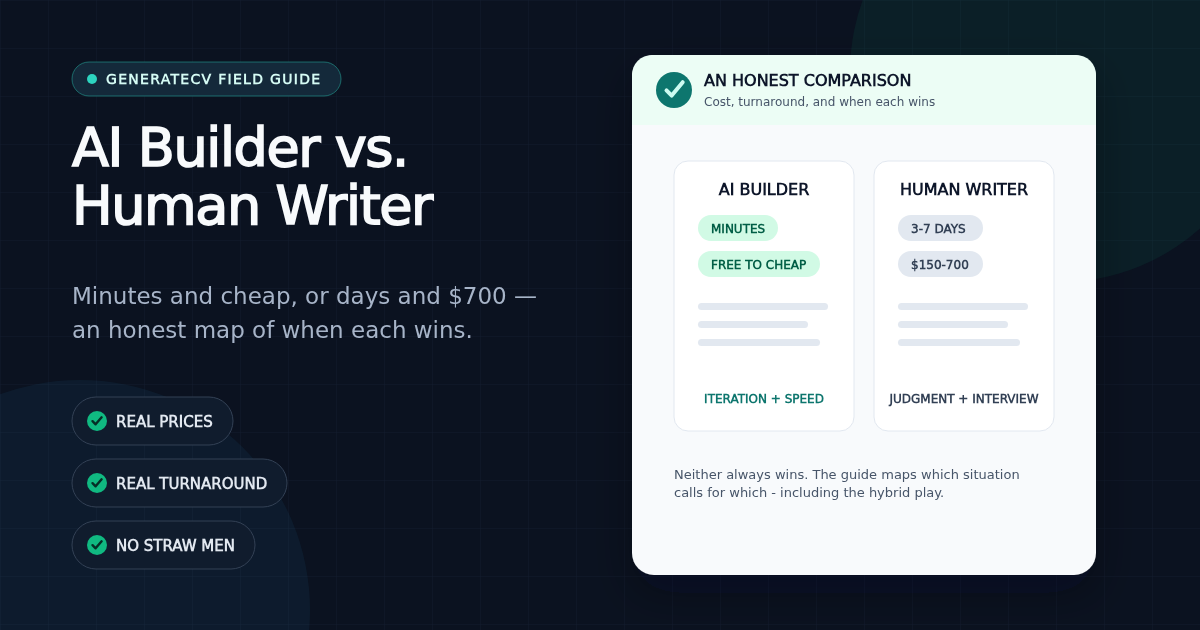
- A professional resume writer typically costs $150–$700 and takes 3–7 days; a modern AI resume builder is minutes and free-to-cheap.
- AI wins on speed, iteration, and tailoring to each job; human writers win on deep narrative for senior or career-change stories.
- ATS performance depends on structure and keyword match, not on who typed the words — both can pass or fail.
- The best 2026 workflow is hybrid: let AI draft and ATS-check, then apply human judgment on the story.
- GenerateCV combines conversational AI drafting with built-in ATS scoring so you get most of the writer's value without the wait or the invoice.
If your resume isn't landing interviews, you have two obvious upgrades: hire a professional resume writer, or use an AI resume builder. Both promise the same outcome — a sharper, more competitive resume — but they get there in very different ways, at very different costs. This guide compares them honestly on the three things that actually matter: cost, turnaround, and ATS effectiveness.
Cost: hundreds of dollars vs. free-to-cheap
A professional resume writer is a service, and it's priced like one. Entry-level packages usually start around $150, mid-career rewrites land in the $300–$500 range, and executive or specialist writers can charge $700 or more — often with add-ons for cover letters and LinkedIn rewrites. You're paying for a person's time and expertise, and every significant revision can mean another round of billing.
An AI resume builder flips that model. The marginal cost of generating and re-generating a draft is tiny, so the tools are free or a small one-time/low subscription cost. That difference compounds when you're actively job hunting: tailoring the same base resume to twelve different postings costs nothing extra with AI, but would be twelve conversations (and twelve invoices) with a writer.
Turnaround: days vs. minutes
With a human writer, expect an intake questionnaire or call, then a drafting window of roughly 3–7 business days, then a revision cycle. It's thorough, but it's slow — and job postings don't wait. If a role closes on Friday and you found it Wednesday, a multi-day turnaround is a problem.
AI resume builders produce a complete first draft in minutes, and revisions are instant. That speed isn't just convenience — it changes strategy. You can tailor a resume to each specific job description while the posting is still fresh, instead of sending one generic document everywhere.
ATS effectiveness: it's about structure, not the author
There's a myth that only professional writers know the "secret" to beating applicant tracking systems. In reality, ATS performance comes down to two mechanical things: whether your resume parses cleanly into the system's database, and whether it uses the vocabulary the recruiter searches for. Neither is exclusive to humans or machines.
A great writer will naturally mirror the job's language and keep the layout parser-friendly. But a good AI builder can do the same thing systematically — matching keywords from the job description and enforcing a clean, single-column-safe structure — and, crucially, it can measure the result. That's the real edge in 2026: not who wrote the words, but whether the tool tells you how findable your resume actually is before you hit submit.
Where each one genuinely wins
- AI resume builder wins when you need speed, want to tailor to many roles, are budget-conscious, or want objective ATS feedback and unlimited iteration.
- Professional writer wins when you have a complex narrative — a senior leadership arc, a career pivot, an employment gap that needs careful framing — and you want a human strategist to shape the story with you.
The 2026 answer is usually hybrid
You don't have to choose in the abstract. The most effective workflow we see: let AI draft the structure, match the job's keywords, and run an ATS check so you know the resume is findable — then apply human judgment (yours, a mentor's, or a writer's) to the parts that need real story. You get most of the strategic value of a writer without the multi-day wait or the recurring invoice.
That's exactly what GenerateCV is built for. Instead of a blank template, you talk to a conversational AI advisor that interviews you the way a good writer would, drafts tailored bullet points, and then scores your resume against the job with a built-in ATS checker — all in minutes, and free to start. It's the fastest way to get a draft that's both well-written and provably findable, so you can spend your energy on applying, not formatting.
Whichever route you pick, judge the result by the same standard: does it parse cleanly, speak the recruiter's language, and tell a clear story? Get those three right and the price tag on the tool matters far less than what it helped you land.
Check your resume free — no signup
See how your resume scores against real ATS filters in seconds.
Related Articles
Who Actually Hires Juniors? 157,622 Live Postings, Counted
We counted every live posting on our job corpus by seniority marker. The entry-level wall is real, but it is wildly uneven by field — and 72% of postings never declare a level at all.
Read articleThe Most In-Demand Skills of 2026, From 102,486 Live Job Postings
We pattern-matched 102,486 live openings on 2,273 company career boards. The most-demanded skills aren't tools: collaboration (61%) and communication (57%) outrank every named technology — Python tops the tool list at 15.6% — and certifications now appear about as often as bachelor's degrees.
Read articleWhat 105,000 Live Job Postings Reveal About the 2026 Job Market
First-party data from 2,036 company career boards: 48% of postings now mention AI, real openings close in a median of 13 days, 1 in 6 'open' jobs is 60+ days old, and senior titles outnumber entry-level 15 to 1.
Read article